
In today’s global market, navigating Saudi Arabia’s evolving logistics landscape requires a trusted partner with deep regional insights. This article provides a concise, practical overview of Saudi transport fundamentals, current regulatory and infrastructure trends, and how to identify a reliable Middle East forwarding service. You’ll discover why Japan-made products are in high demand overseas and how a seamless, all-in-one solution—from procurement to delivery—can slash costs and elevate reliability. Learn how to compare costs, assess vendor credibility, and choose a partner that offers comprehensive services—procurement, inspection, packaging, forwarding, customs, and delivery—tailored for both individuals and businesses. With real-world guidance on pricing, service scope, and risk management, you’ll be equipped to request quotes, initiate inquiries, and accelerate shipments to Saudi Arabia and beyond. Buy Japanese products from Japan via a streamlined proxy shopping and forwarding service, leveraging global reach to over 200 countries, backed by 15+ years of trade expertise and end-to-end support. For a trusted, cost-efficient path to the Middle East, explore how our one-stop procurement and logistics solution can deliver high-quality outcomes and peace of mind.
- Japan-Based Proxy Purchasing Companies for Acquiring Japanese Products
- Shipping Rates from Japan to the United Arab Emirates (UAE), Arab Countries, and the Middle East
- How It Works
- Step 1: Prepare the Shipment
- Step 2: Email the Shipping Documents to Us (Invoice + Packing Details)
- Step 3: We Email You the Two Documents Required for Shipment (Air Waybill/Label + Invoice)
- Step 4: Courier Pickup at Your Location / Domestic Warehouse — Shipment Dispatched
- Step 5: Delivery and Receipt
- Input Format
- Transaction Flow (Detailed Version)
- Transit Time
- Cost Components
- Shipping Cost from Japan to UAE, Arab Countries, and the Middle East
- Foundations of Saudi Arabia Transportation
- Strategic Guide to Choosing Affordable and Reliable Middle East Forwarding Partners
- Emerging Trends and Market Dynamics
- How to Place an Order (Easy Japan Proxy Buying & International Shipping)
- Japanese Product Shopping Agent Service – Buy from Japan and Ship Worldwide
- Supported Japanese Shopping Platforms
- Recommended Transport Intermediaries for the Middle East
- Unlocking Japanese Products: Introduction to a Trusted Japanese Sourcing Agent
- Operational Implementation Guide
- Shipping Rates from Japan to the United Arab Emirates (UAE), Arab Countries, and the Middle East
- How It Works
- Step 1: Prepare the Shipment
- Step 2: Email the Shipping Documents to Us (Invoice + Packing Details)
- Step 3: We Email You the Two Documents Required for Shipment (Air Waybill/Label + Invoice)
- Step 4: Courier Pickup at Your Location / Domestic Warehouse — Shipment Dispatched
- Step 5: Delivery and Receipt
- Input Format
- Transaction Flow (Detailed Version)
- Transit Time
- Cost Components
- Shipping Cost from Japan to UAE, Arab Countries, and the Middle East
- How to Choose an Affordable and Reliable Logistics Forwarding Partner for the Middle East
- Premium Freight Forwarding Partners for the Middle East
- Operational Practical Guide
Japan-Based Proxy Purchasing Companies for Acquiring Japanese Products

For international buyers seeking genuine Japanese goods, leveraging a trusted proxy purchasing service from Japan offers a seamless, reliable pathway. A proficient proxy service blends sourcing from diverse channels—both online marketplaces and brick-and-mortar stores—into a single, streamlined experience. This article outlines key Japanese platforms that deliver readily purchasable items, explains why Japanese products command strong demand overseas, and highlights a comprehensive export proxy service that combines purchasing and export logistics at competitive prices. Our focus remains on reliability, efficiency, and end-to-end support for businesses and individuals worldwide.
Wide range of websites where Japanese products can be bought
Accessing Japanese goods through reputable platforms is essential for ensuring authenticity, quality, and timely delivery. The following sites are commonly used by proxy purchasing services to source both new and used items:
– Amazon.co.jp (https://www.amazon.co.jp/): A vast catalog covering electronics, household items, fashion, and more. Many sellers offer reliable shipping options, with options for bulk ordering and product inspection pre-shipment.
– Rakuten (https://www.rakuten.co.jp/): A major marketplace with extensive categories, including regional products and exclusive items. Proxy buyers leverage Rakuten for competitive pricing and access to limited editions.
– Yahoo! Shopping (https://shopping.yahoo.co.jp/): A diverse platform featuring brand-name goods, daily essentials, and seasonal releases, often with promotional rates and seller ratings.
– Mercari (https://jp.mercari.com/): A popular marketplace for pre-owned and vintage items, ranging from electronics to fashion. Useful for sourcing value items and rare finds in good condition.
– Uniqlo (https://www.uniqlo.com/jp/ja/): For apparel basics, seasonal collections, and collaboration lines, with strong regional availability and consistent stock across Japan.
– BicCamera (https://www.biccamera.com/): A leading electronics retailer, ideal for cameras, gadgets, and home electronics with reliable packaging and shipping options.
– ZOZOTOWN (https://zozo.jp/): A fashion-forward platform offering clothing, accessories, and streetwear from popular brands, including limited releases.
– Yahoo! Auctions (https://auctions.yahoo.co.jp/): Auction-based access to rare items, collectibles, and surplus stock, which can yield bargains when managed by an experienced proxy buyer.
– LOHACO (https://lohaco.yahoo.co.jp/): Everyday essentials and lifestyle goods, useful for quick replenishment orders and small-volume shipments.
Beyond these sites, a skilled proxy service can source from many additional channels upon request. This flexibility ensures access to hard-to-find items, limited runs, and wholesale opportunities not readily available to individual buyers.
Why Japanese products enjoy high demand overseas
Japanese goods captivate international buyers for several reasons. First, renowned craftsmanship and materials deliver superior quality across electronics, fashion, beauty, and home goods. Second, Japan’s reputation for innovation yields cutting-edge technology and unique design aesthetics. Third, strict quality control and reliable brand storytelling foster consumer trust. Finally, strategic product lifecycles—limited editions, seasonal lines, and authentic regional specialties—drive appeal for collectors and enthusiasts. For businesses, sourcing high-quality items from Japan translates into stronger market positioning and higher perceived value, which in turn supports premium pricing and customer loyalty.
Introducing an export proxy company that offers affordable, high-quality, end-to-end purchasing and shipping
Partnering with a trusted export proxy company that combines procurement, inspection, packaging, international shipping, customs clearance, and local delivery creates a truly seamless experience. Key advantages include:
- Consistent cost savings: By eliminating middlemen and leveraging our in-house logistics, we offer competitive rates for both small bundles and large corporate orders.
- Comprehensive service: From initial order to final delivery, a single point of contact coordinates every step, minimizing miscommunication and delays.
- Quality assurance: Pre-shipment inspections, secure packaging, and damage prevention measures ensure goods arrive in optimal condition.
- Global reach: With capability to ship to over 200 countries, including Middle East clients, our network supports both individual and corporate buyers.
- Legal and regulatory expertise: Our team understands import/export regulations, duties, and documentation, reducing risk and streamlining customs clearance.
For inquiries, please contact us through the official channel: https://worldwide-courier-japan.com/#contact
Shipping Rates from Japan to the United Arab Emirates (UAE), Arab Countries, and the Middle East

◇Shipping Rate Table (Prices Shown as Rate per Weight)
Japan→the United Arab Emirates (UAE), Arab Countries, and the Middle East
【the United Arab Emirates (UAE), Arab Countries, and the Middle East Export — Preferred Rates】
0.5kg :3,649 JPY
1kg :4,353 JPY
1.5kg :5,195 JPY
2kg :5,822 JPY
2.5kg :6,485 JPY
3kg :7,095 JPY
3.5kg :7,741 JPY
4kg :8,316 JPY
4.5kg :8,981 JPY
5kg :9,554 JPY
5.5kg :10,298 JPY
6kg :10,870 JPY
6.5kg :11,317 JPY
7kg :11,836 JPY
7.5kg :12,356 JPY
8kg :12,559 JPY
8.5kg :12,764 JPY
9kg :12,930 JPY
9.5kg :13,209 JPY
10kg :13,431 JPY
10.5kg:25,080 JPY
11kg :25,552 JPY
11.5kg:26,020 JPY
12kg :26,492 JPY
12.5kg:26,994 JPY
13kg :27,463 JPY
13.5kg:27,857 JPY
14kg :28,292 JPY
14.5kg:28,723 JPY
15kg :29,266 JPY
15.5kg:29,481 JPY
16kg :29,555 JPY
16.5kg:29,626 JPY
17kg :29,660 JPY
17.5kg:29,731 JPY
18kg :29,768 JPY
18.5kg:29,808 JPY
19kg :29,950 JPY
19.5kg:30,024 JPY
20kg :30,058 JPY
※UPS fastest service level with tracking number included.※
※We also support Japan Post EMS, International ePacket, standard air shipping, SAL, and sea freight. If you prefer any of these options, please let us know.。
※UPS fastest service level with tracking number included※
【the United Arab Emirates (UAE), Arab Countries, and the Middle East Export — Preferred Rates】
・21-49kg :1,200 JPY per kg
・50-99kg :990 JPY per kg
・100-299kg:850 JPY per kg
・300-499kg:830 JPY per kg
・500-999kg:820 JPY per kg
・1000-2000kg:790 JPY per kg
The above rates are quoted as a per-kilogram unit price. For the total shipping cost by weight bracket, please refer to the examples on the right.
In addition to the shipping charges above, a fuel surcharge will apply. Fuel surcharge rates may be revised monthly or weekly depending on the carrier you use.
Customs duties, import VAT/sales tax, and other destination charges incurred at local customs clearance will be billed to the consignee (recipient) by the carrier.
How It Works
world wide courier provides international logistics and air freight forwarding services for trading businesses that need professional shipping support.
We support both export and import shipments to and from the United Arab Emirates (UAE), Arab countries, the Middle East, China, Hong Kong, South Korea, Europe, North America, Southeast Asia, India, Africa, and many other countries worldwide.

By using major courier networks (FedEx, UPS, DHL), we ensure stable and fast delivery. In addition, our highly competitive shipping rates help reduce your ongoing logistics costs and lower your overall procurement cost.
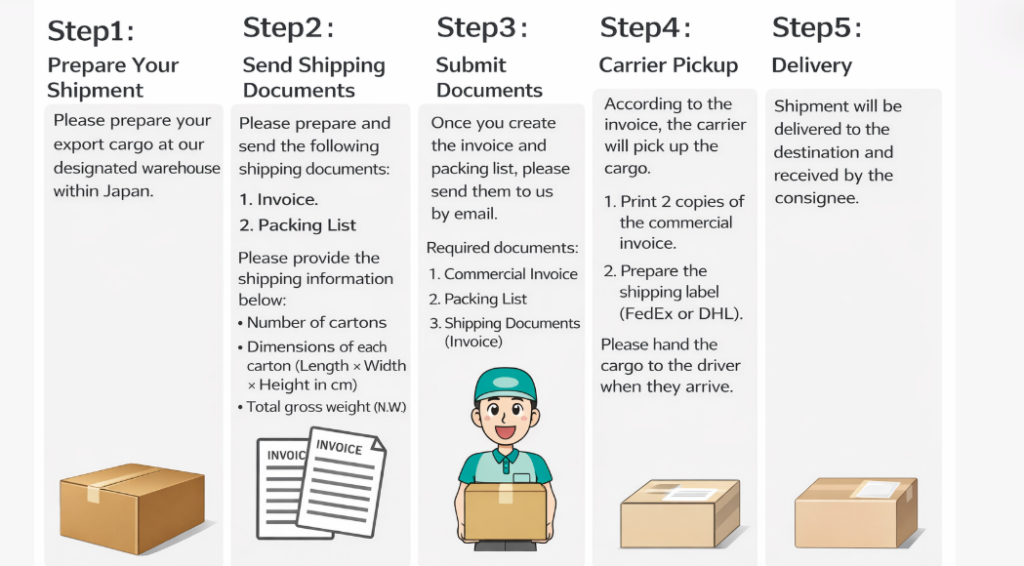
Step 1: Prepare the Shipment
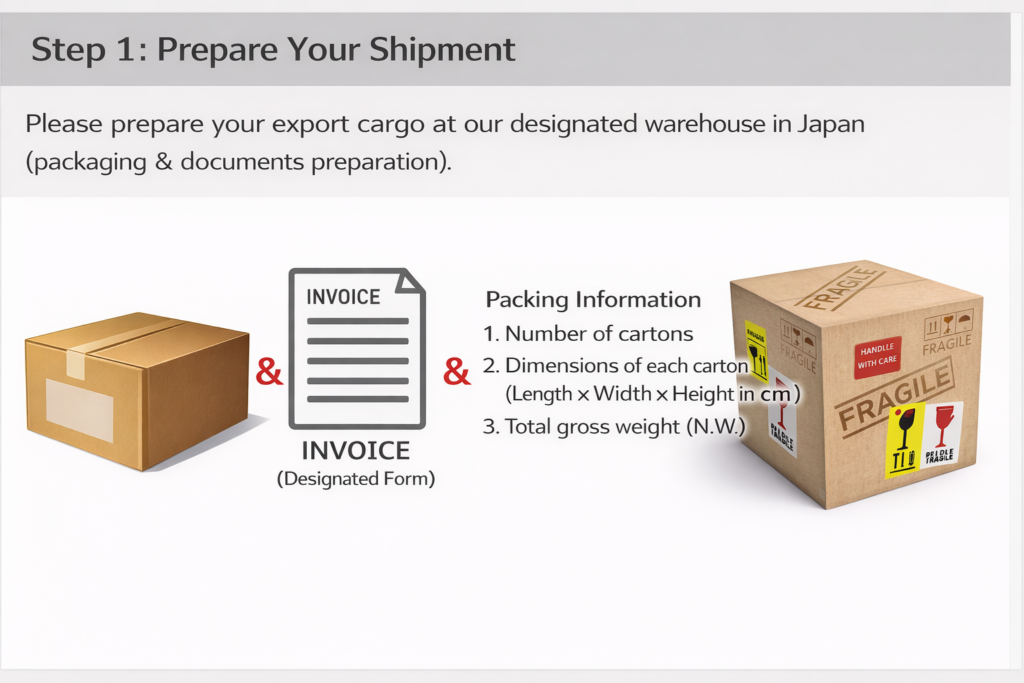
Prepare the shipment at the domestic pickup location (packing and documentation preparation).
Step 2: Email the Shipping Documents to Us (Invoice + Packing Details)
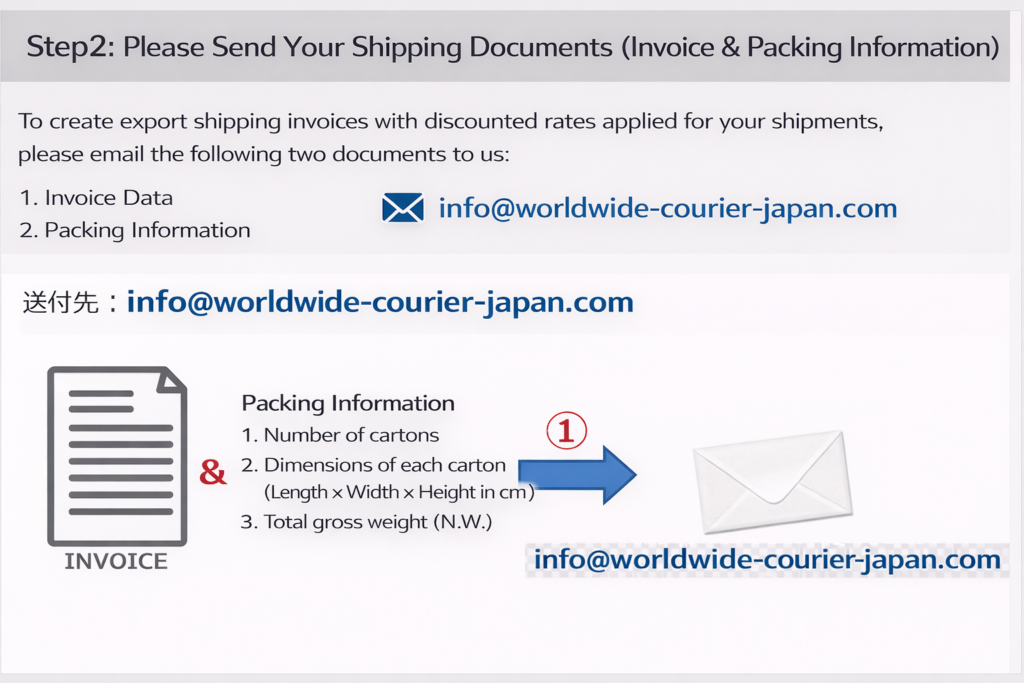
We will create the shipping documents using the special discounted rates provided for each customer. Please email the following two documents to our office as attachments.
1. “Invoice”
2. “Packing List”
Email: info@worldwide-courier-japan.com
<Common Invoice Items That Are Often Missing>
1. Postal code (shipper side / pickup location)
2. Contact person name (shipper side)
3. Phone number for the pickup location (shipper side)
※The above three items are required to create the documents.
If any of these are missing, we cannot issue the documents, so please confirm in advance before requesting shipping.
<Required Packing List Information>
1. Total number of cartons/boxes
2. Dimensions of each carton (L cm × W cm × H cm — all three sides required)
3. Total weight (N.W.): total weight after packing
※In some cases, the packing list is missing these required details. These are necessary for document creation, so please confirm in advance.
※If you do not have a packing list, please confirm the above information with the shipper and share it with us.
<About “Chargeable Weight,” Which Determines the Shipping Cost>
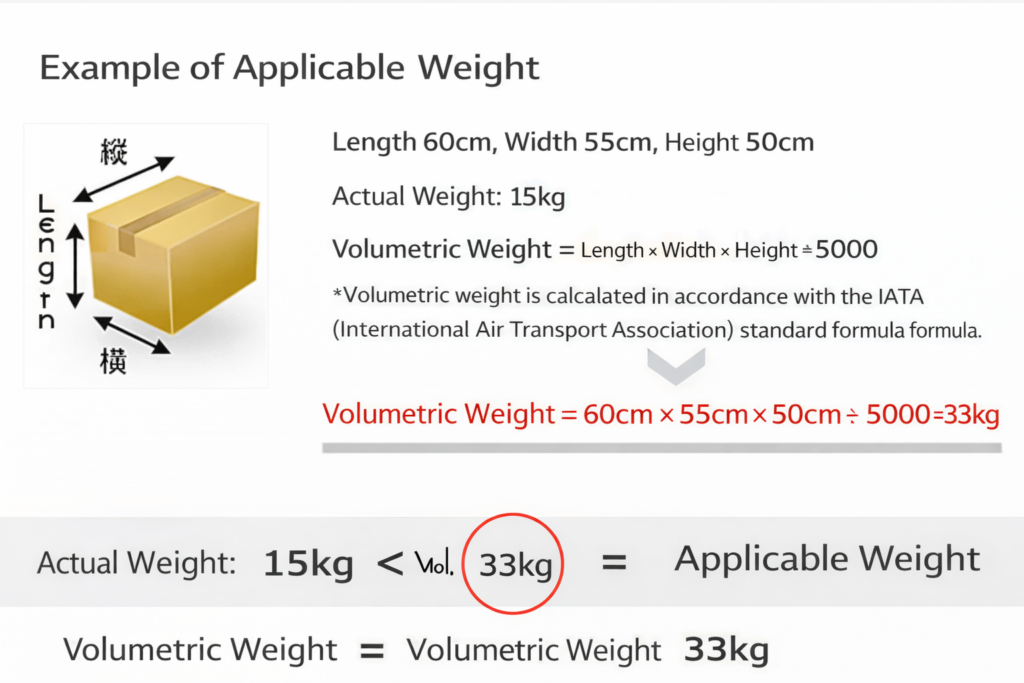
Based on IATA (International Air Transport Association) standards, the greater of the “actual weight after packing” and the “volumetric (dimensional) weight” is used as the “chargeable weight.”
Step 3: We Email You the Two Documents Required for Shipment (Air Waybill/Label + Invoice)
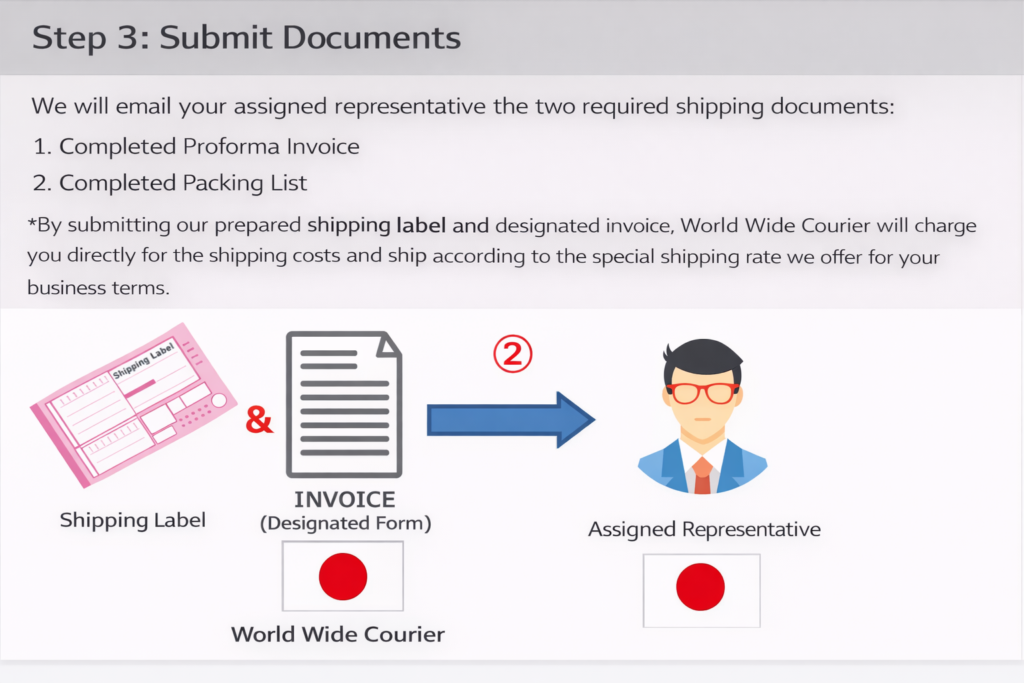
We will email the two documents required for shipping (air waybill/label and invoice) to your 담당者.
1. We confirm missing details in the “Invoice” and “Packing List” you provided.
2. Based on those documents, we create the “Air Waybill/Label” and the “Invoice (official format)” and email them to you.
※When you ship using the documents created by us, the shipping charges are billed to us. This allows you to ship using your customer-specific discounted rates. Under your trading terms, we will invoice you for the shipping charges accordingly.
Step 4: Courier Pickup at Your Location / Domestic Warehouse — Shipment Dispatched
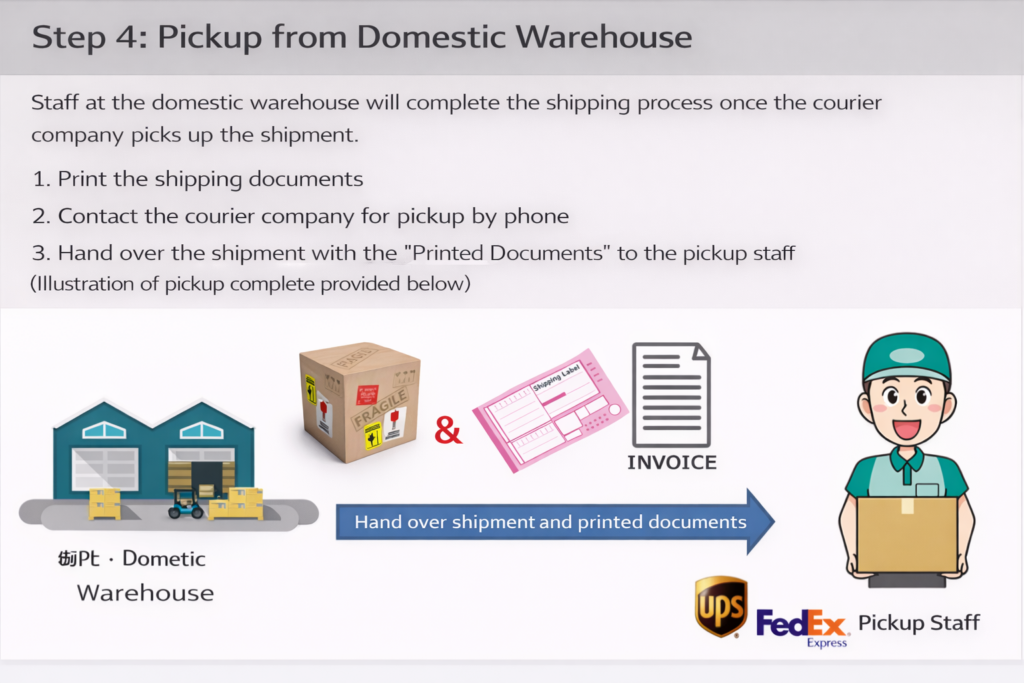
At the pickup location in Japan:
1. Print the documents
2. Call the courier to request pickup
3. Hand the shipment and the two printed documents to the pickup driver to complete dispatch
Step 5: Delivery and Receipt
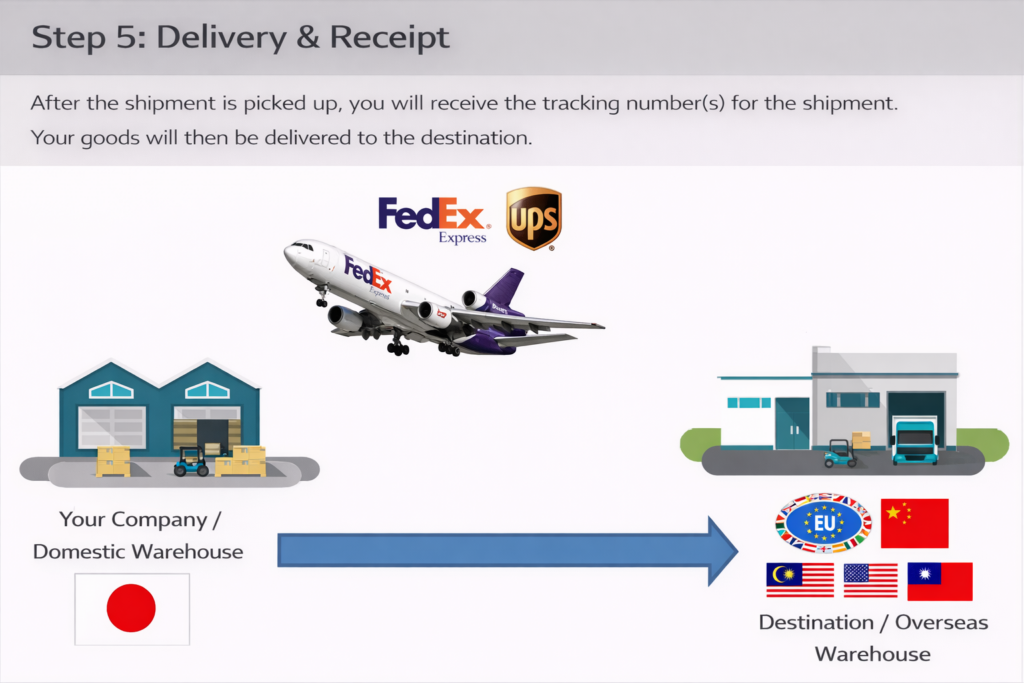
After dispatch, we will provide your tracking number. The shipment will then be delivered to the destination.

We offer good service.world wide courier offers affordable international delivery from Japan to the United Arab Emirates (UAE), Arab Countries, and the Middle East via air freight and sea freight. We support both exports and imports, so please contact us for a consultation or inquiry.
If you provide the information below, we can create the shipping label and documents for your shipment.
Input Format
◇Pickup Information (From)
1. Company name (or personal name)
2. Contact person name
3. Postal code
4. Address
5. Phone number
※This is the actual pickup location information.
◇Delivery Address (To)
1. Company name (or personal name) (※Must be written in English.)
2. Contact person name (※Must be written in English.)
3. Postal code
4. Address (※Must be written in English.)
5. Phone number
◇Packing Information
1. Number of cartons
2. Total weight
3. Dimensions of each carton (Length, Width, Height in cm)
◇Invoice Information
・Product name (Must be written in English.)
・Unit price (any currency is acceptable)
・Quantity
Once we receive the information above, we can arrange your shipment. world wide courier provides affordable shipping from Japan to the United Arab Emirates (UAE), Arab Countries, and the Middle East via air freight and sea freight, and we support both exports and imports. Please contact us anytime.
We look forward to your request.
Please let us know your current shipping frequency and shipping costs if available, as it will help us propose the best solution.
Regarding your planned shipping date:
If you can tell us your expected shipment date, the process will be smoother and faster.
You can ship using the above rates.
For export shipments, you may reply with the completed invoice attached, or you may provide the information below so that we can create the shipping documents.
◇Pickup Information (From)
1. Company name (or personal name)
2. Contact person name
3. Postal code
4. Address
5. Phone number
※This is the actual pickup location information.
◇Delivery Address (To)
1. Company name (or personal name) (※Must be written in English.)
2. Contact person name (※Must be written in English.)
3. Postal code
4. Address (※Must be written in English.)
5. Phone number
◇Packing Information
1. Number of cartons
2. Total weight
3. Dimensions of each carton (Length, Width, Height in cm)
◇Invoice Information
・Product name (Must be written in English.)
・Unit price (any currency is acceptable)
・Quantity
We will also guide you through the transaction flow.
Transaction Flow (Detailed Version)
<Flow>
1. Please reply with your completed invoice.
2. If there are no issues with the information, we will book the pickup.
※In the fastest case, pickup will be scheduled for the next business day after your request (typically between 11:00 and 17:00).
<Details: Export Shipment / Transaction Flow (Japan → Destination Country)>
The pickup process is as follows.
1. After packing is complete, please contact us.
2. Please prepare the invoice and packing information (number of cartons, weight, and carton dimensions).
※2-1. Shipper (Japan side) address, postal code, name, phone number, and company name
2-2. Consignee (delivery destination) address, postal code, name, phone number, and company name
2-3. Product name and unit price
3. After we confirm item 2, if there are no issues, we will arrange the pickup.
4. Pickup will be made within 1–2 business days at your designated location.
*We will email the electronic air waybill/label, so please provide the invoice and label together with the shipment to the pickup driver.
5. Shipment is dispatched.
7. Destination customs clearance process (personal or commercial)
8. If there are no issues, the shipment clears customs.
9. Delivery is completed.
*If there are no issues, steps 5–8 typically take about 2–5 days for arrival.
*A tracking number will be issued as a shipping record.
Transit Time

Estimated Delivery Days (Japan → the United Arab Emirates (UAE), Arab Countries, and the Middle East)
Estimated delivery time is approximately 3–5 days from the local dispatch date.
Delivery may be delayed due to customs conditions, weather, or other unforeseen circumstances. Thank you for your understanding.
world wide courier provides affordable delivery from Japan to the United Arab Emirates (UAE), Arab Countries, and the Middle East via air freight and sea freight. We support both exports and imports, so please contact us for inquiries or consultations.
Cost Components
1. Shipping fee + fuel surcharge (billed by us to you)
2. Import duty, import VAT/sales tax, customs clearance fees, and other charges incurred at destination customs (billed by the carrier to the recipient)
About “chargeable weight,” which determines shipping costs:
Based on IATA standards, the larger of “actual packed weight” and “volumetric (dimensional) weight” is used as the chargeable weight.
Shipping Cost from Japan to UAE, Arab Countries, and the Middle East
The cost of shipping from Japan to the UAE, Arab countries, and the Middle East depends on several factors including package weight, parcel dimensions, shipping method, and delivery speed.
For example, sending a small parcel weighing approximately two kilograms from Japan to the UAE, Arab countries, or the Middle East using EMS may cost around 4,000 to 8,000 yen depending on the parcel size.
Courier services such as DHL may charge higher shipping fees but provide faster delivery times and more detailed tracking services. Many businesses choose courier services for urgent shipments or important international deliveries.
For larger shipments or commercial exports, air cargo services may offer lower shipping costs compared with express courier shipments.
Foundations of Saudi Arabia Transportation

Saudi Arabia’s logistics landscape blends vast geography with a growing industrial base, creating a dynamic framework for international shippers. The market is characterized by a strong emphasis on road and air connectivity, expanding port capacity along the Red Sea and Persian Gulf, and ongoing privatization of logistics services to improve efficiency. With a strategic location at the crossroads of Asia, Europe, and Africa, Saudi Arabia is increasingly integral to global supply chains. The government’s Vision 2030 initiative accelerates infrastructure modernization, digital freight solutions, and domestic production incentives, all of which elevate reliability, transit times, and cost-effectiveness for international buyers and sellers.
Saudi Arabia’s Logistics Market Characteristics
The Saudi logistics market benefits from substantial public and private investment, a diversified transport network, and a favorable policy environment for cross-border trade. Key features include:
- Extensive road network: The majority of domestic freight moves by road, supported by highways and logistics hubs that connect major cities, industrial zones, and cross-border corridors with Kuwait, the UAE, and other Gulf states.
- Growing air and sea capacity: New and expanded airports and export-oriented Free Zones boost air cargo throughput, while the Red Sea and Gulf Coast ports expand container handling and project cargo capabilities.
- Customs modernization: Streamlined customs procedures, risk-based inspections, and digital documentation reduce clearance times and enhance predictability for importers and exporters.
- Domestic manufacturing push: A push toward local production reduces reliance on imports for certain sectors (electronics, automotive components, consumer goods), expanding opportunities for procurement and value-added services.
- Supportive regulatory environment: Clear framework for freight, warehousing, and cross-border activities, with incentives for foreign investors and logistics service providers to establish regional hubs.
- Public-private partnerships: Private operators gain access to concessions and tenders for port, airport, and road upgrades, driving efficiency, capacity, and service breadth.
For buyers and sellers, these dynamics translate into improved service levels, broader supplier access, and scalable solutions for growth markets in and beyond Saudi Arabia.
Overview by Transportation Mode
Understanding the main modes helps tailor procurement and shipping strategies for Saudi Arabia. Each mode offers distinct advantages, lead times, and practical considerations for international buyers and distributors.
- Road transport: The backbone of domestic distribution and regional cross-border flows. Road freight provides flexible routing, door-to-door delivery, and rapid replenishment for B2B and B2C channels. Capacity and service reliability improve with improved highway networks and digitized freight management.
- Air cargo: Ideal for high-value, time-sensitive, or smaller-volume shipments. Saudi hubs and expanding international connections enable fast transit to and from major markets. Sea-to-air transshipments are common for balancing speed and cost in large-volume orders.
- Maritime shipping: Key for bulk goods, equipment, and heavy cargo. Strategic ports (on the Red Sea and Gulf) support containerized trade and project cargo. Transit times are longer than air but cost-efficient for large or non-urgent shipments.
- Rail (emerging): Ongoing projects and cross-border links are expanding rail options for certain corridors, offering lower carbon footprint and potential cost efficiency for heavy freight.
- Multimodal solutions: Integrated door-to-door services that combine ocean/air with road transport to optimize speed, cost, and risk—particularly valuable for cross-border e-commerce and regional distribution.
Businesses exporting to Saudi Arabia or sourcing from it should assess urgency, product type, and total landed cost to select the most suitable mode or combination. With a comprehensive, end-to-end logistics partner, you can align procurement with Saudi market demand while maintaining control over compliance, packaging, and delivery timelines.
Strategic Guide to Choosing Affordable and Reliable Middle East Forwarding Partners

In the competitive landscape of cross-border shipping to the Middle East, selecting a forwarder who combines cost efficiency with dependable service is essential. A top-tier partner should offer transparent pricing, robust compliance, and end-to-end support—from purchase代理 to delivery—while maintaining high standards of protection for goods. This chapter outlines practical criteria and actionable tips to compare costs and measure reliability, helping international buyers and businesses make informed decisions.
Cost Comparison: Key Considerations for Middle East Shipments
Effective cost comparison goes beyond quoted freight rates. Consider the following elements to ensure you’re getting true value for money:
– All-inclusive pricing: Look for door-to-door quotes that consolidate purchasing代理 fees, consolidation, pick-and-pack, packaging, origin and destination handling, and customs clearance. Hidden charges for documentation, fuel surcharges, or storage should be clearly disclosed upfront.
– Freight mode mix: Airfreight offers speed but higher costs, while seafreight provides cost efficiency for bulky or non-urgent shipments. A knowledgeable forwarder should propose an optimal mix based on item type, urgency, and budget.
– Consolidation and accessorials: Evaluate charges for consolidation, unbundling, and special handling (fragile items, electronics, or perishables). A forwarder with effective consolidation can reduce unit costs dramatically.
– Packaging and protection: Adequate packaging prevents damage and returns, which can be expensive. Compare the cost of protective materials and custom crates, against the risk of loss or damage in transit.
– Insurance options: Transit insurance should be optional but recommended. Assess premium levels, coverage limits, and claims processes—lower rates are not beneficial if coverage is insufficient.
– Duty, taxes, and clearance costs: Some forwarders include broker fees and duties in the estimate, while others bill separately. A single, transparent calculation helps avoid surprises at delivery.
– Payment terms and currency: Favor partners offering stable payment terms and favorable FX handling to minimize financial exposure.
Practical tip: request a sample comparison for a typical shipment (e.g., electronics or apparel) across 2–3 forwarders to visualize real-world differences in total landed cost and service scope.
Reliability Indicators: How to Assess a Forwarder’s Trustworthiness
Reliability is built on proven capabilities, consistent performance, and transparent operations. Use these indicators when evaluating potential partners:
– Track record and experience: Prefer forwarders with 10+ years in international logistics and demonstrable experience serving Middle East destinations. Verify their global network breadth and ability to handle complex supply chains.
– Compliance competence: The right partner has deep knowledge of customs regulations, sanctions, import controls, and product-specific restrictions for key Middle East markets. They should provide proactive guidance to prevent delays and penalties.
– End-to-end service coverage: A one-stop solution that covers purchasing代理, quality inspection, packing, forwarding, customs clearance, and last-mile delivery reduces risk and improves timelines.
– Real-time visibility: Access to online tracking, status updates, and proactive exception management keeps you informed and reduces management overhead.
– Risk management and contingency planning: Look for documented processes for incident response, damage claims, route optimization, and alternative options during peak seasons or disruptions.
– Quality control and protection: Confirm that the forwarder conducts pre-shipment inspections, uses protective packaging, and applies damage-prevention protocols. Clear claims procedures for damaged or missing items should be in place.
– Financial stability and insurance): Ensure the company has solid financial health and offers cargo insurance options with straightforward claims handling to minimize losses.
– Customer references: Seek testimonials and case studies from clients with similar shipment profiles and regions. Direct references can reveal strengths and pitfalls not evident in general marketing materials.
– Sustainability and ethics: For long-term partnerships, evaluate environmental practices, compliant labor standards, and responsible sourcing policies, which increasingly influence business continuity and brand reputation.
Application tip: prepare a standard questionnaire covering these reliability indicators and use it during vendor shortlisting to ensure apples-to-apples comparisons.
Emerging Trends and Market Dynamics

The Saudi logistics landscape is rapidly evolving, driven by regulatory updates, modernization efforts, and sustained infrastructure investments. For international buyers and freight forwarders, understanding these shifts is essential to optimize routes, ensure compliant shipments, and capitalize on efficiency gains. This section summarizes the latest regulatory and infrastructural developments shaping Saudi Arabia’s transport and logistics ecosystem.
Latest regulatory and customs updates
Saudi regulatory reforms continue to streamline cross-border trade, reduce clearance times, and enhance compliance certainty for both imports and exports. Key themes include harmonization with international customs standards, digitalization of customs procedures, and the rollout of risk-based screening to expedite low-risk shipments. Notable initiatives often involve:
– Transition to paperless processes through e-forms and electronic submission of documents, enabling faster approvals.
– Updated tariff classifications and simplified import licenses for commonly traded goods, reducing administrative bottlenecks for SMEs and multinational buyers alike.
– Strengthened export controls and post-clearance audit mechanisms to improve tariff accuracy and reduce disputes.
– Enhanced alignment with international sanctions regimes and anti-corruption measures to foster a transparent trading environment.
For international buyers, proactive compliance is essential. Partners should maintain accurate commercial invoices, packing lists, origin certificates, and any product-specific certifications. Close collaboration with a knowledgeable customs broker—well-versed in Saudi regulations—helps prevent delays, penalties, and cargo holds. Our team specializes in navigating these regulatory nuances, offering end-to-end support from purchasing to final delivery.
Infrastructure investment and logistics efficiency initiatives
Saudi Arabia’s sustained infrastructure push aims to enhance connectivity, reduce transit times, and lower overall logistics costs. Major programs are advancing across multimodal corridors, ports, airports, and warehousing networks. Highlights include:
– Expansion and modernization of major ports along the Red Sea and the Arabian Gulf to boost container throughput and reliability for international shipments.
– Upgrades to rail and road networks to create integrated supply chains that shorten last-mile and intermodal transfer times.
– Development of logistics parks and free zones with advanced warehousing, cold-chain capabilities, and value-added services to support cross-border e-commerce and regional distribution.
– Digitization of cargo operations, including real-time tracking, electronic data interchange with carriers, and automated customs processing to improve visibility and reduce dwell times.
These investments translate into tangible benefits for customers, such as:
– More predictable transit times and improved on-time delivery performance.
– Lower intermediary costs due to streamlined handoffs between modes and optimized routing.
– Expanded capacity for high-volume and high-value goods, including electronics, automotive parts, and consumer electronics.
For buyers and exporters, aligning procurement schedules with these infrastructure improvements can unlock faster, more cost-efficient fulfillment. Our integrated services—purchase assistance, inspection, packaging, transportation, and customs support—are designed to leverage these developments, delivering reliable, end-to-end solutions for markets including Saudi Arabia and beyond.
Japan product agent service
We can buy Japanese products and ship them to countries worldwide.
We provide both international shipping and purchasing services, so we can handle both the purchase of products in Japan and the shipment to your country.
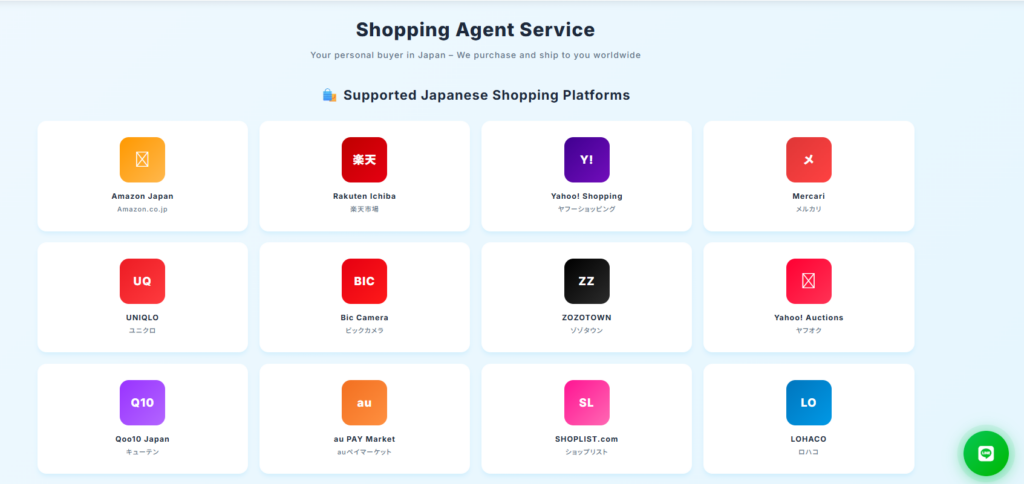
Buy Authentic Japanese Products with Our Trusted Shopping Agent Service. We help customers worldwide purchase items directly from popular Japanese online stores such as Amazon Japan, Rakuten, Yahoo! Shopping, Mercari, and more. If a store does not ship internationally, we buy on your behalf and deliver safely to your country. Enjoy access to exclusive Japanese brands, limited editions, electronics, fashion, cosmetics, and collectibles at competitive prices. Our service offers secure payments, careful inspection, reliable packaging, and fast international shipping.
How to Place an Order (Easy Japan Proxy Buying & International Shipping)
To place an order, please send us the required information via email, LINE, or our contact form. Once we confirm your details, we will issue a proforma invoice with a complete cost breakdown.
Required Information for Your Order
- Product URL(s) from Japanese websites (e.g., Amazon Japan, Rakuten, Mercari)
- Quantity (number of items)
- Delivery Address (full address including postal code and phone number)
- Preferred Delivery Schedule (desired shipping date or deadline)
Order Process
- Send your order details via email, LINE, or contact form
- Receive a proforma invoice including product cost, service fee, and shipping cost
- Confirm your order and complete payment
- We purchase the items from Japan on your behalf
- Your products are shipped safely to your destination
Why Choose Our Japan Proxy Buying Service?
- Access to popular Japanese marketplaces and exclusive products
- Affordable international shipping rates
- Secure payment and professional handling
- Reliable support for global customers and businesses
Contact us today to start your order and enjoy fast, reliable access to authentic Japanese products.
Japanese Product Shopping Agent Service – Buy from Japan and Ship Worldwide
Our Japanese Shopping Agent Service allows customers around the world to purchase authentic products directly from Japan. Many Japanese online stores do not ship internationally, which makes it difficult for overseas buyers to access popular and exclusive Japanese products. Our service solves this problem by purchasing items on your behalf and shipping them safely to your country.
We support a wide range of popular Japanese online marketplaces and retail stores. Whether you are looking for fashion, electronics, cosmetics, collectibles, hobby items, anime goods, daily-use products, or limited Japanese products, we can help you purchase them and arrange reliable international shipping.
We can also help you purchase products from smaller Japanese websites, specialty stores, local shops, and suppliers that may not support overseas customers. In many cases, if the product can be bought in Japan, we can help you buy it. This makes our service ideal for customers in Malta who want flexible access to almost anything sold in Japan.
Our service is suitable for:
• personal shopping from Japan
• Japan proxy buying
• e-commerce sourcing
• wholesale and bulk orders
• limited-edition and hard-to-find Japanese products
• combined shipping to reduce international delivery costs
CTA: If you have a product link, product name, screenshot, or shopping list, send it to us through our contact form. We will check availability, provide support, and help you buy and ship your items from Japan smoothly and safely.
Supported Japanese Shopping Platforms
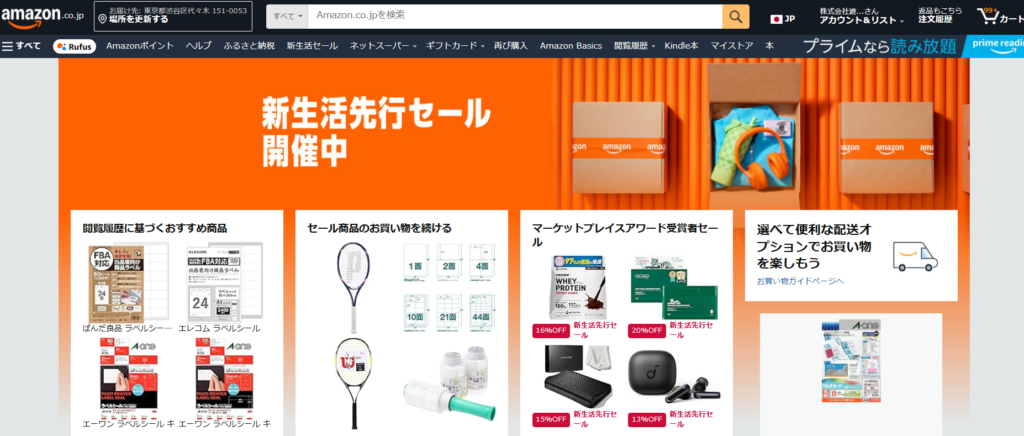
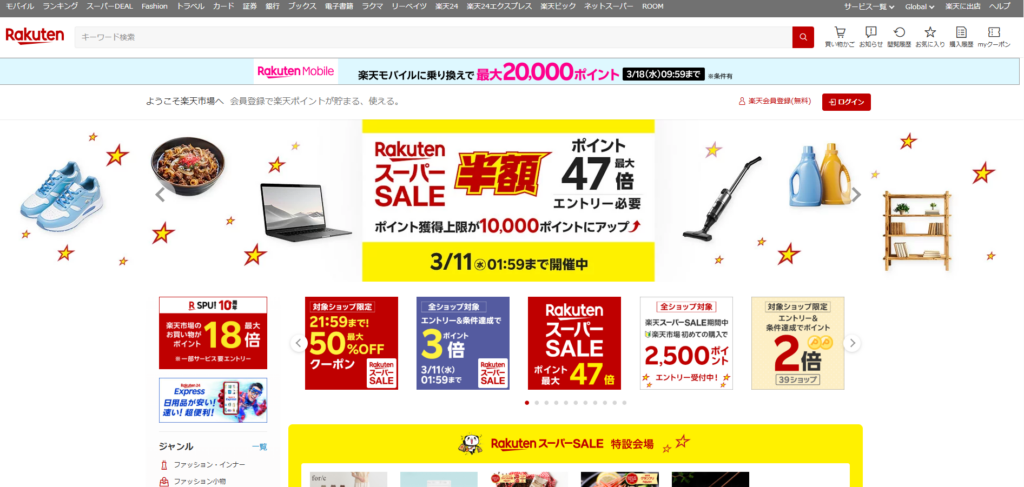
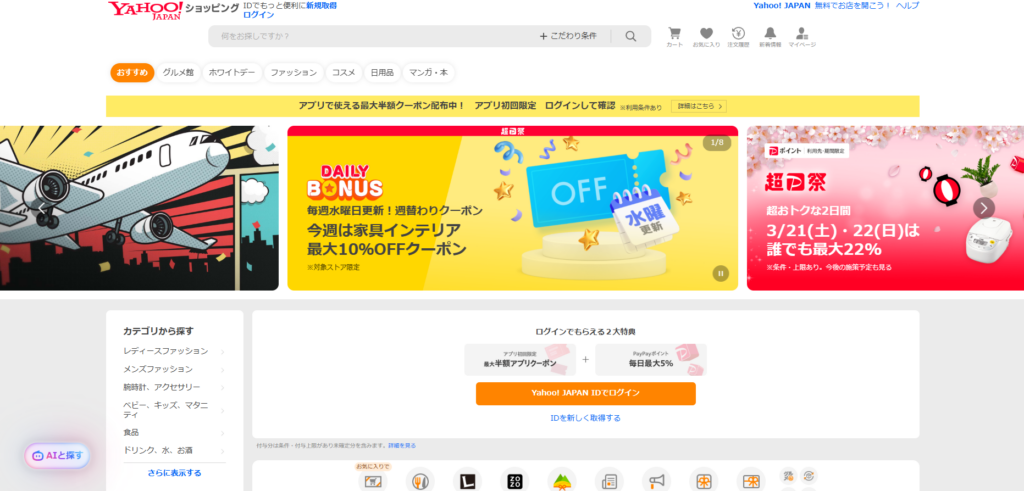
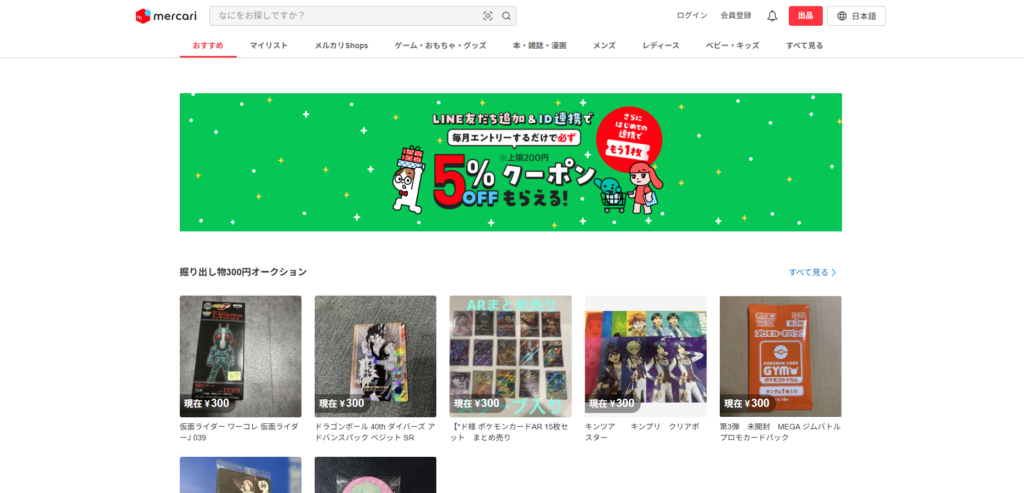

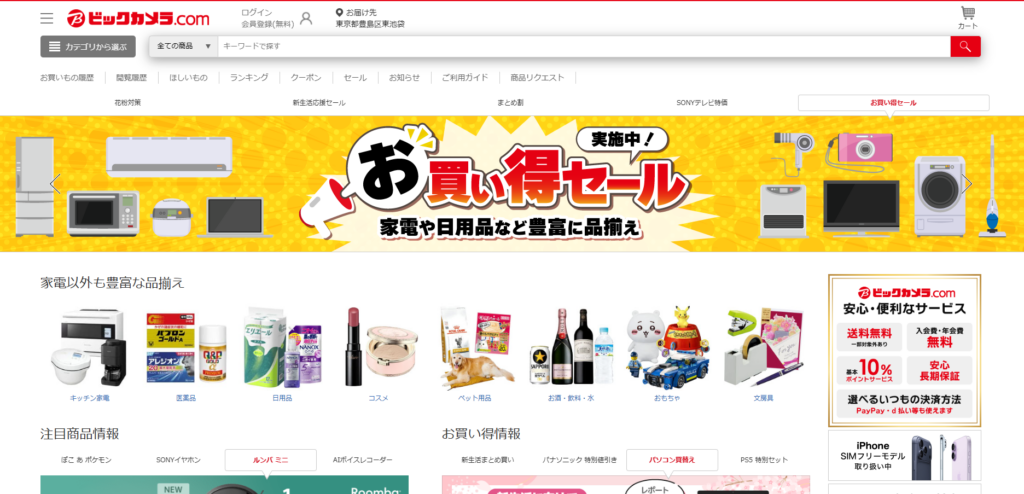
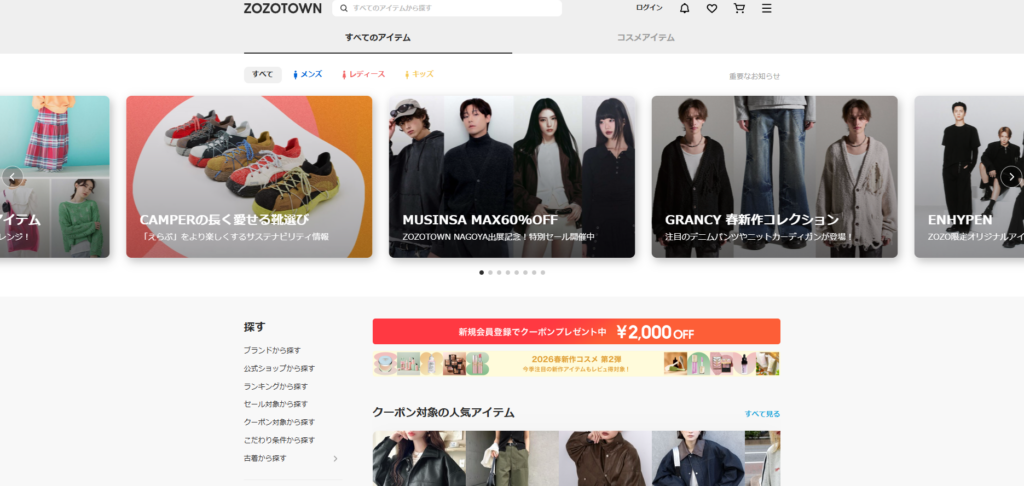
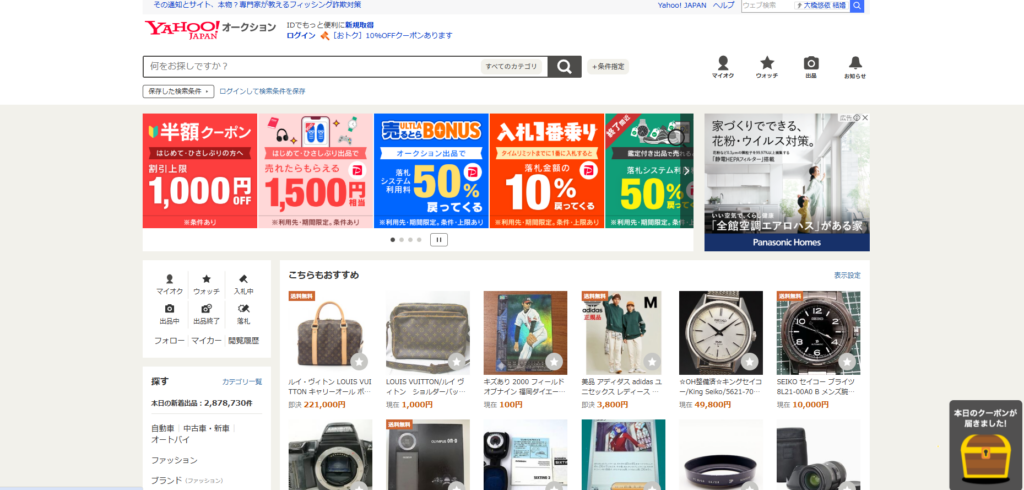
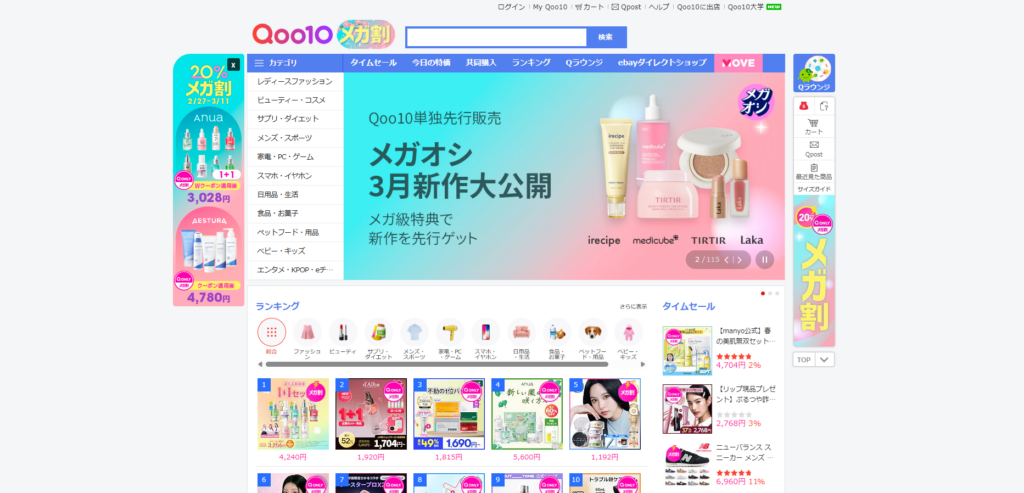
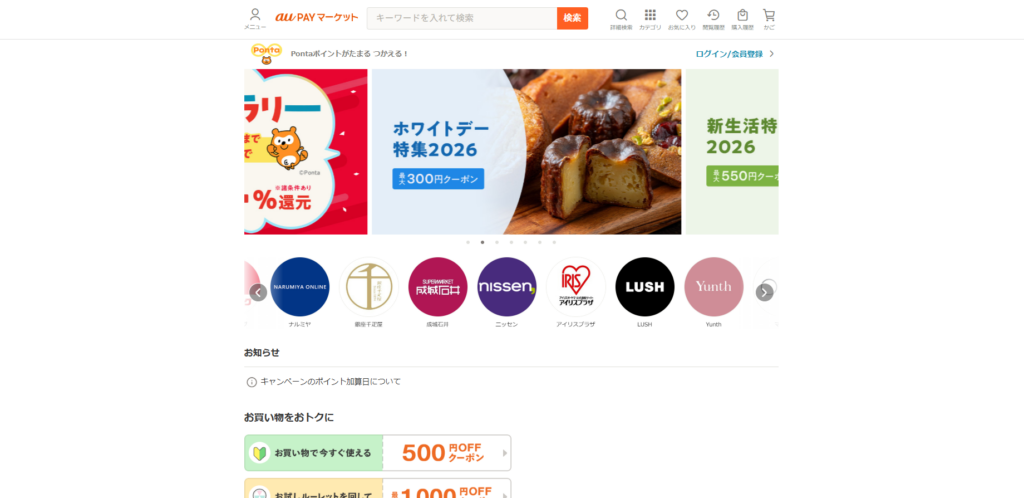
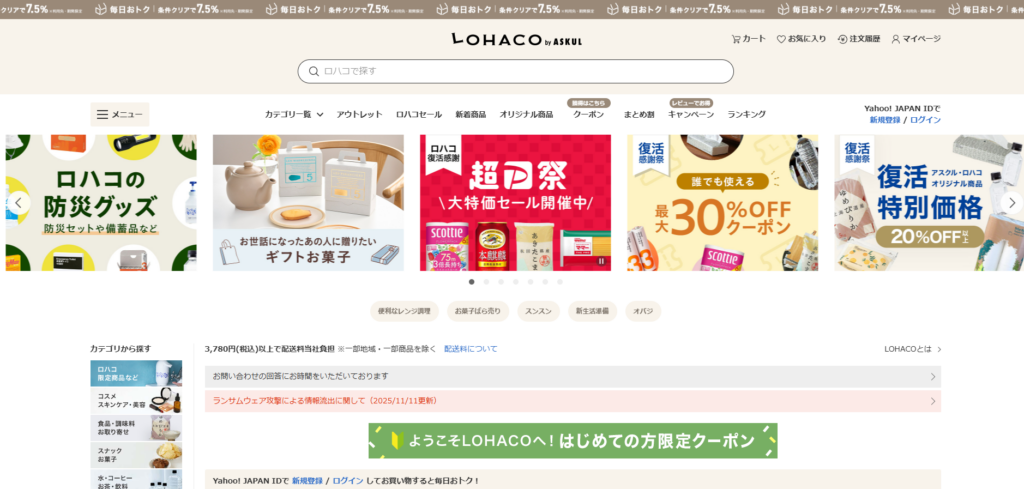
These platforms offer a huge variety of Japanese products that are highly popular worldwide. From the latest Japanese fashion brands to high-quality electronics, cosmetics, lifestyle goods, hobby items, and unique collectibles, you can access many of Japan’s best online stores through our purchasing service.
Even if the product you want is not listed on one of the major platforms above, you can still contact us. We can often assist with purchases from smaller Japanese websites, independent online shops, brand-specific stores, and selected offline products available in Japan. This makes our service highly flexible for customers who want to buy almost anything from Japan.
Contact us through the form below. Please send us your order item links or shopping list. Orders can be placed by chat or email, whichever is more convenient for you.
Recommended Transport Intermediaries for the Middle East

Choosing a reliable logistics partner is crucial for success when targeting the Middle East market. An ideal transport intermediary should combine cost-efficient shipping, comprehensive service offerings, and a track record of customer satisfaction. For global merchants, the right partner not only moves goods but also streamlines compliance, customs, and last-mile delivery across diverse Middle Eastern markets. This section highlights top contenders that excel in price competitiveness and service breadth, as well as those with proven performance and high client satisfaction.
Companies with robust pricing and comprehensive services
In the Middle East corridor, cost efficiency without compromising service quality is essential. Leading firms in this space typically offer:
– Transparent, competitive pricing models that minimize hidden fees and optimize total landed cost
– End-to-end solutions: procurement support, consolidation, packaging, international freight (air and ocean), customs clearance, and final delivery
– Flexible service tiers to accommodate both individuals and businesses, including consolidated shipments for smaller orders and full-container loads for bulk importers
– Strong regional coverage, including hubs and agents across GCC countries, Egypt, Jordan, and Turkey, enabling faster transit times and reliable handoffs
Why this matters: a partner with balanced pricing and a broad service lineup reduces the need for multiple vendors, lowers overall costs, and enhances predictability of delivery timelines for Middle Eastern customers. Look for carriers that can claim a wide catalog of product handling capabilities (new, used, high-value electronics, fashion, cosmetics, and industrial supplies) and that can connect with Japan-based suppliers seamlessly. For Japan-origin procurement, a capable intermediary should provide Buy Japanese products from Japan strategies, combined with a robust forwarding service that covers air and sea freight to the Middle East.
Companies with proven performance and high customer satisfaction
A provider’s reputation is built on consistency, reliability, and responsive support. Key indicators of a dependable intermediary include:
– Demonstrated track record across multiple Middle Eastern markets (KSA, UAE, Qatar, Bahrain, Kuwait, Oman, Jordan, Egypt, Turkey, etc.)
– Transparent performance metrics: on-time delivery rates, damage-free shipment rates, and proactive issue resolution
– Comprehensive customer support including multilingual assistance, real-time tracking, and post-delivery follow-up
– Strong compliance awareness: up-to-date knowledge of local import regulations, documentation requirements, and duty/tax handling
– Capability to handle diverse product streams: consumer electronics, apparel, home goods, automotive parts, and industrial supplies
Partners with these strengths can significantly reduce risk and elevate buyer confidence for Middle Eastern shipments. They often provide value-added services such as pre-shipment inspection, quality control, and packaging optimization to reduce damage and improve transit safety. When evaluating, consider not only price but also the reliability score, escalation procedures, and the ability to offer a one-stop solution from Japan procurement to door delivery in the Middle East.
Unlocking Japanese Products: Introduction to a Trusted Japanese Sourcing Agent
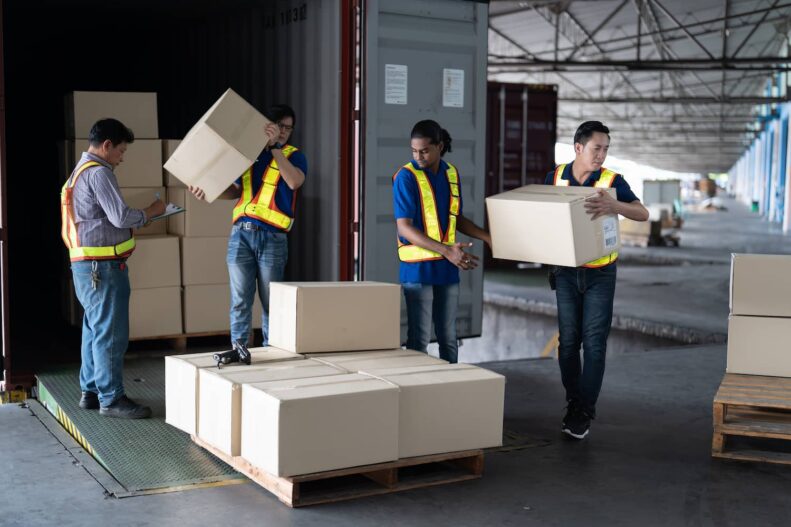
In today’s global marketplace, accessing authentic Japanese goods from overseas can be challenging due to language barriers, shipping complexities, and payment concerns. A reliable Japanese sourcing agent bridges these gaps, enabling buyers worldwide to acquire high-quality products—from electronics and fashion to limited editions and collectibles—without the usual hurdles. This article introduces top Japanese sourcing and export services that combine procurement expertise with seamless international logistics, helping you Buy Japanese products from Japan with confidence and efficiency.
Websites Where Japanese Products Can Be Purchased
To maximize your options, consider reputable Japanese e-commerce platforms and marketplaces that offer direct-to-consumer or international shipping, often through trusted proxy services. Key sites include:
Amazon.co.jp (https://www.amazon.co.jp/) offers a vast catalog of new and used items across categories, with reliable seller ratings and robust fulfillment options. Rakuten Ichiba (https://www.rakuten.co.jp/) is a major marketplace featuring diverse products from numerous merchants, including many domestic brands. Yahoo! Shopping (https://shopping.yahoo.co.jp/) provides curated selections and merchant partnerships for local Japanese products. Mercari (https://jp.mercari.com/) is ideal for finding second-hand or limited items at competitive prices. Uniqlo (https://www.uniqlo.com/jp/ja/) and Bic Camera (https://www.biccamera.com/) showcase fashion and electronics respectively, with strong brand presence and product authenticity. ZoZo Town (https://zozo.jp/) specializes in fashion and lifestyle goods with a focus on trendy Japanese brands. Yahoo Auctions (https://auctions.yahoo.co.jp/) offers auction-based access to collectibles and rare items. Lohaco (https://lohaco.yahoo.co.jp/) provides everyday essentials from trusted retailers. If you have products in mind beyond these platforms, a capable Japanese sourcing agent can request and consolidate items from additional sites on your behalf.
Note: Even if a site is not listed here, a dedicated sourcing service can typically obtain items from other Japanese retailers upon request, ensuring you never miss an opportunity to buy authentic Japanese products.
Why Japanese Products Are in High Demand Overseas
Several factors drive the global appeal of Japanese goods:
- Exceptional quality control and meticulous craftsmanship across sectors—from electronics and cosmetics to fashion and anime merchandise.
- Strong brand heritage and design influence that resonates with discerning international buyers.
- Limited regional availability or exclusive editions that create scarcity and value for overseas markets.
- Reliability and after-sales support that bolster consumer trust in Japanese brands and retailers.
By leveraging a Japanese proxy shopping service and a comprehensive export process, buyers gain access to new, authentic items with reduced risk and optimized costs, all while benefiting from the stronger consumer perception of Japanese products worldwide.
Introducing Cost-Effective, High-Quality Export Services That Combine Purchasing and Export
For businesses seeking a seamless end-to-end solution, a one-stop export service combining purchase代理 (proxy buying) and export logistics offers clear advantages:
- Professional procurement across Japan’s EC platforms and retail networks, including新品,中古,限定品, and auction items, ensuring a broad product spectrum.
- Cost efficiency through an in-house logistics network, eliminating middleman margins and passing savings to customers.
- Global reach—shipping to over 200 countries with scalable options for individuals and corporations.
- Expertise in customs, regulatory compliance, and risk mitigation with 15+ years of trade experience.
- End-to-end support: purchasing, inspection, packaging, shipping, customs clearance, and final delivery, all managed under one roof.
Partnering with a trusted export agent enables Buy Japanese products from Japan with confidence, particularly for mid-to-large volume orders or ongoing sourcing programs for corporate buyers and cross-border sellers.
Operational Implementation Guide

In the fast-paced world of cross-border logistics, a well-structured operations plan is essential to ensure reliability, speed, and cost efficiency. This section provides practical guidance for establishing robust practices when engaging with shipment and procurement services targeting Saudi Arabia, while maintaining a seamless flow from purchase to delivery. It emphasizes a one-stop approach that covers procurement, inspection, packaging, shipping, customs, and delivery for a smooth customer experience.
Key Contractual Checkpoints
Thorough contracts lay the foundation for successful partnerships in international shipping to Saudi Arabia. Focus on these essential clauses and processes to minimize ambiguity and protect value for both sides.
- Scope of services: Clearly define purchasing support, inspection, packing, shipping (air/sea), customs clearance, and last-mile delivery. Include any value-added services such as consolidation, labeling, or hazardous materials handling.
- Service levels and timelines: Establish target lead times for procurement, inspection, packaging, and transit. Include remedies for delays, such as service credits or expedited options.
- Pricing and payment terms: Detail all fees (procurement, inspection, packing, freight, insurance, duties, taxes) and currency, payment milestones, and dispute resolution mechanisms. Include clarity on mid-year rate adjustments.
- Incoterms and risk transfer: Specify the point at which risk transfers (e.g., FCA, DAP) and who bears duties, taxes, and import clearance costs for Saudi shipments.
- Quality standards and inspection criteria: Define inspection scope (quantity, functionality, authenticity, packaging condition) and acceptance criteria. Include sampling methods and documentation (photos, reports) as evidence of conformity.
- Packaging and injury prevention: Set packaging requirements that minimize damage in transit, including cushioning, seal integrity, and labeling standards suitable for Saudi logistics networks.
- Liability and insurance: Outline coverage for loss or damage, including per-event and aggregate limits, claim procedures, and subrogation waivers where applicable.
- Compliance and regulatory control: Confirm adherence to Saudi import rules, product standards, labeling, and localization requirements. Include a plan for regulatory changes and notification timelines.
- Data privacy and security: Address handling of sensitive supplier/product data, access controls, and data retention policies aligned with international standards.
- Termination and exit strategies: Define termination rights, notice periods, and responsibilities for incomplete orders, returns, or stranded inventory.
- Dispute resolution: Provide escalation pathways, governing law (preferably Saudi or neutral jurisdiction), and mechanisms such as mediation or arbitration.
- Performance metrics and governance: Establish KPIs (on-time procurement, inspection accuracy, damage rate, transit time, customer satisfaction) and a regular review cadence with accountable owners.
Proactive contract design reduces friction and accelerates trust-building, especially when coordinating multi-country logistics and procurement networks serving Saudi Arabia.
Risk Mitigation and Trouble Prevention
Operational resilience hinges on anticipating risks and implementing practical controls. The following strategies help prevent disruptions and protect margins when buying Japanese products and delivering to Saudi buyers.
- Supplier due diligence: Vet suppliers for reliability, regulatory compliance, and product provenance. Maintain an approved vendor list with performance history and risk ratings tailored to Saudi-bound shipments.
- Inventory and order visibility: Implement real-time inventory tracking and order status updates to manage lead times and avoid stockouts or overstock in the Saudi supply chain.
- Regulatory vigilance: Monitor changes in Saudi import policies, tariffs, labeling, and product safety standards. Establish a rapid-response team to interpret regulatory updates and adjust procurement specs accordingly.
- Chain-of-custody controls: Enforce end-to-end traceability from purchase to delivery. Use serial numbers, batch records, and tamper-evident packaging where appropriate to deter diversion.
- Packaging optimization: Align packaging with Saudi customs and climate conditions to minimize damage and shrinkage. Include robust outer packaging and protective interior materials for fragile goods.
- Insurance and contingency planning: Maintain appropriate cargo insurance with clear claims procedures. Create contingency routes and alternative carriers to mitigate port congestion or capacity gaps.
- Fraud prevention: Establish authentication steps for supplier invoices, purchase orders, and shipment documents. Use digital signatures and secure communication channels to reduce tampering risk.
- Disruption response playbooks: Develop step-by-step responses for common disruptions (delay in procurement, carrier delay, customs hold, incorrect paperwork). Include predefined roles, communication templates, and escalation timelines.
- Quality control feedback loop: Capture post-delivery feedback from Saudi customers to refine product specs, packaging, and inspection criteria. Use data to drive supplier improvements and reduce returns.
- Cybersecurity and data integrity: Protect sensitive procurement and shipment data from cyber threats. Enforce access controls, encryption for data in transit, and secure data backups.
With disciplined contract governance and proactive risk controls, operations can sustain high service levels, minimize disruptions, and preserve profitability when serving the Saudi market.
Shipping Rates from Japan to the United Arab Emirates (UAE), Arab Countries, and the Middle East
◇Shipping Rate Table (Prices Shown as Rate per Weight)
Japan→the United Arab Emirates (UAE), Arab Countries, and the Middle East
【the United Arab Emirates (UAE), Arab Countries, and the Middle East Export — Preferred Rates】
0.5kg :3,649 JPY
1kg :4,353 JPY
1.5kg :5,195 JPY
2kg :5,822 JPY
2.5kg :6,485 JPY
3kg :7,095 JPY
3.5kg :7,741 JPY
4kg :8,316 JPY
4.5kg :8,981 JPY
5kg :9,554 JPY
5.5kg :10,298 JPY
6kg :10,870 JPY
6.5kg :11,317 JPY
7kg :11,836 JPY
7.5kg :12,356 JPY
8kg :12,559 JPY
8.5kg :12,764 JPY
9kg :12,930 JPY
9.5kg :13,209 JPY
10kg :13,431 JPY
10.5kg:25,080 JPY
11kg :25,552 JPY
11.5kg:26,020 JPY
12kg :26,492 JPY
12.5kg:26,994 JPY
13kg :27,463 JPY
13.5kg:27,857 JPY
14kg :28,292 JPY
14.5kg:28,723 JPY
15kg :29,266 JPY
15.5kg:29,481 JPY
16kg :29,555 JPY
16.5kg:29,626 JPY
17kg :29,660 JPY
17.5kg:29,731 JPY
18kg :29,768 JPY
18.5kg:29,808 JPY
19kg :29,950 JPY
19.5kg:30,024 JPY
20kg :30,058 JPY
※UPS fastest service level with tracking number included.※
※We also support Japan Post EMS, International ePacket, standard air shipping, SAL, and sea freight. If you prefer any of these options, please let us know.。
※UPS fastest service level with tracking number included※
【the United Arab Emirates (UAE), Arab Countries, and the Middle East Export — Preferred Rates】
・21-49kg :1,200 JPY per kg
・50-99kg :990 JPY per kg
・100-299kg:850 JPY per kg
・300-499kg:830 JPY per kg
・500-999kg:820 JPY per kg
・1000-2000kg:790 JPY per kg
The above rates are quoted as a per-kilogram unit price. For the total shipping cost by weight bracket, please refer to the examples on the right.
In addition to the shipping charges above, a fuel surcharge will apply. Fuel surcharge rates may be revised monthly or weekly depending on the carrier you use.
Customs duties, import VAT/sales tax, and other destination charges incurred at local customs clearance will be billed to the consignee (recipient) by the carrier.
How It Works
world wide courier provides international logistics and air freight forwarding services for trading businesses that need professional shipping support.
We support both export and import shipments to and from the United Arab Emirates (UAE), Arab countries, the Middle East, China, Hong Kong, South Korea, Europe, North America, Southeast Asia, India, Africa, and many other countries worldwide.
By using major courier networks (FedEx, UPS, DHL), we ensure stable and fast delivery. In addition, our highly competitive shipping rates help reduce your ongoing logistics costs and lower your overall procurement cost.
Step 1: Prepare the Shipment
Prepare the shipment at the domestic pickup location (packing and documentation preparation).
Step 2: Email the Shipping Documents to Us (Invoice + Packing Details)
We will create the shipping documents using the special discounted rates provided for each customer. Please email the following two documents to our office as attachments.
1. “Invoice”
2. “Packing List”
Email: info@worldwide-courier-japan.com
<Common Invoice Items That Are Often Missing>
1. Postal code (shipper side / pickup location)
2. Contact person name (shipper side)
3. Phone number for the pickup location (shipper side)
※The above three items are required to create the documents.
If any of these are missing, we cannot issue the documents, so please confirm in advance before requesting shipping.
<Required Packing List Information>
1. Total number of cartons/boxes
2. Dimensions of each carton (L cm × W cm × H cm — all three sides required)
3. Total weight (N.W.): total weight after packing
※In some cases, the packing list is missing these required details. These are necessary for document creation, so please confirm in advance.
※If you do not have a packing list, please confirm the above information with the shipper and share it with us.
<About “Chargeable Weight,” Which Determines the Shipping Cost>
Based on IATA (International Air Transport Association) standards, the greater of the “actual weight after packing” and the “volumetric (dimensional) weight” is used as the “chargeable weight.”
Step 3: We Email You the Two Documents Required for Shipment (Air Waybill/Label + Invoice)
We will email the two documents required for shipping (air waybill/label and invoice) to your 담당者.
1. We confirm missing details in the “Invoice” and “Packing List” you provided.
2. Based on those documents, we create the “Air Waybill/Label” and the “Invoice (official format)” and email them to you.
※When you ship using the documents created by us, the shipping charges are billed to us. This allows you to ship using your customer-specific discounted rates. Under your trading terms, we will invoice you for the shipping charges accordingly.
Step 4: Courier Pickup at Your Location / Domestic Warehouse — Shipment Dispatched
At the pickup location in Japan:
1. Print the documents
2. Call the courier to request pickup
3. Hand the shipment and the two printed documents to the pickup driver to complete dispatch
Step 5: Delivery and Receipt
After dispatch, we will provide your tracking number. The shipment will then be delivered to the destination.
We offer good service.world wide courier offers affordable international delivery from Japan to the United Arab Emirates (UAE), Arab Countries, and the Middle East via air freight and sea freight. We support both exports and imports, so please contact us for a consultation or inquiry.
If you provide the information below, we can create the shipping label and documents for your shipment.
Input Format
◇Pickup Information (From)
1. Company name (or personal name)
2. Contact person name
3. Postal code
4. Address
5. Phone number
※This is the actual pickup location information.
◇Delivery Address (To)
1. Company name (or personal name) (※Must be written in English.)
2. Contact person name (※Must be written in English.)
3. Postal code
4. Address (※Must be written in English.)
5. Phone number
◇Packing Information
1. Number of cartons
2. Total weight
3. Dimensions of each carton (Length, Width, Height in cm)
◇Invoice Information
・Product name (Must be written in English.)
・Unit price (any currency is acceptable)
・Quantity
Once we receive the information above, we can arrange your shipment. world wide courier provides affordable shipping from Japan to the United Arab Emirates (UAE), Arab Countries, and the Middle East via air freight and sea freight, and we support both exports and imports. Please contact us anytime.
We look forward to your request.
Please let us know your current shipping frequency and shipping costs if available, as it will help us propose the best solution.
Regarding your planned shipping date:
If you can tell us your expected shipment date, the process will be smoother and faster.
You can ship using the above rates.
For export shipments, you may reply with the completed invoice attached, or you may provide the information below so that we can create the shipping documents.
◇Pickup Information (From)
1. Company name (or personal name)
2. Contact person name
3. Postal code
4. Address
5. Phone number
※This is the actual pickup location information.
◇Delivery Address (To)
1. Company name (or personal name) (※Must be written in English.)
2. Contact person name (※Must be written in English.)
3. Postal code
4. Address (※Must be written in English.)
5. Phone number
◇Packing Information
1. Number of cartons
2. Total weight
3. Dimensions of each carton (Length, Width, Height in cm)
◇Invoice Information
・Product name (Must be written in English.)
・Unit price (any currency is acceptable)
・Quantity
We will also guide you through the transaction flow.
Transaction Flow (Detailed Version)
<Flow>
1. Please reply with your completed invoice.
2. If there are no issues with the information, we will book the pickup.
※In the fastest case, pickup will be scheduled for the next business day after your request (typically between 11:00 and 17:00).
<Details: Export Shipment / Transaction Flow (Japan → Destination Country)>
The pickup process is as follows.
1. After packing is complete, please contact us.
2. Please prepare the invoice and packing information (number of cartons, weight, and carton dimensions).
※2-1. Shipper (Japan side) address, postal code, name, phone number, and company name
2-2. Consignee (delivery destination) address, postal code, name, phone number, and company name
2-3. Product name and unit price
3. After we confirm item 2, if there are no issues, we will arrange the pickup.
4. Pickup will be made within 1–2 business days at your designated location.
*We will email the electronic air waybill/label, so please provide the invoice and label together with the shipment to the pickup driver.
5. Shipment is dispatched.
7. Destination customs clearance process (personal or commercial)
8. If there are no issues, the shipment clears customs.
9. Delivery is completed.
*If there are no issues, steps 5–8 typically take about 2–5 days for arrival.
*A tracking number will be issued as a shipping record.
Transit Time
Estimated Delivery Days (Japan → the United Arab Emirates (UAE), Arab Countries, and the Middle East)
Estimated delivery time is approximately 3–5 days from the local dispatch date.
Delivery may be delayed due to customs conditions, weather, or other unforeseen circumstances. Thank you for your understanding.
world wide courier provides affordable delivery from Japan to the United Arab Emirates (UAE), Arab Countries, and the Middle East via air freight and sea freight. We support both exports and imports, so please contact us for inquiries or consultations.
Cost Components
1. Shipping fee + fuel surcharge (billed by us to you)
2. Import duty, import VAT/sales tax, customs clearance fees, and other charges incurred at destination customs (billed by the carrier to the recipient)
About “chargeable weight,” which determines shipping costs:
Based on IATA standards, the larger of “actual packed weight” and “volumetric (dimensional) weight” is used as the chargeable weight.
Shipping Cost from Japan to UAE, Arab Countries, and the Middle East
The cost of shipping from Japan to the UAE, Arab countries, and the Middle East depends on several factors including package weight, parcel dimensions, shipping method, and delivery speed.
For example, sending a small parcel weighing approximately two kilograms from Japan to the UAE, Arab countries, or the Middle East using EMS may cost around 4,000 to 8,000 yen depending on the parcel size.
Courier services such as DHL may charge higher shipping fees but provide faster delivery times and more detailed tracking services. Many businesses choose courier services for urgent shipments or important international deliveries.
For larger shipments or commercial exports, air cargo services may offer lower shipping costs compared with express courier shipments.
How to Choose an Affordable and Reliable Logistics Forwarding Partner for the Middle East

Selecting the right logistics forwarder for Middle East shipments is crucial to balance cost, reliability, and speed. This guide outlines practical considerations, concrete benchmarks, and actionable steps to compare providers, ensuring you secure a partner that can handle cross-border e-commerce, commercial freight, and sensitive regulatory requirements with confidence.
Cost comparison considerations
Understanding total landed cost is essential, not just quoted freight rates. Start with a transparent breakdown: base Freight charges, origin handling, export documentation, packaging optimization, insurance options, and any fuel or surcharge adjustments. For Middle East routes, pay attention to:
– Transit time vs. cost: cheaper options may incur longer lead times or higher risk of delays; quantify the value of speed in your business model.
– Consolidation opportunities: LCL versus FCL, customs clearance fees, and potential storage charges at destination.
– DDP vs. DAP: evaluate who bears duties and taxes to avoid unexpected invoices.
– Insurance coverage: confirm policy limits, claim processes, and whether cargo value aligns with the risk profile of the goods (high-value electronics vs. consumer goods).
– Freight payment terms: look for favorable terms that support cash flow, especially for large or recurring orders.
Practical steps:
1) Request a detailed cost sheet for typical shipment profiles (size/weight, HS code, destination).
2) Run a total cost comparison across 3–5 providers for a representative mix of shipments.
3) Probe hidden fees (handling at origin/destination, customs clearance, medical or hazardous material charges, oversized cargo surcharges).
4) Assess the value of bundled services (inspection, packing, labeling, documentation) included in the price.
5) Check currency stability and any multi-currency invoicing to minimize FX risk.
Indicators of reliability
Reliability is built on process discipline, regulatory knowledge, and consistent performance. Evaluate providers against these indicators:
– Track record in Middle East corridors: years of operation, milestone shipments, and client testimonials specific to regional routes.
– Compliance and regulatory expertise: ability to handle export/import controls, sanctions checks, and local customs requirements for destinations such as Saudi Arabia, UAE, Qatar, and beyond.
– Transit performance metrics: on-time delivery rates, average dwell times, and the ability to provide proactive delay notifications.
– Visibility and tracking: real-time shipment visibility, proactive exception management, and accessible customer portals or dashboards.
– Insurance and risk management: robust cargo insurance options, damage control procedures, and documented claims processes.
– Scalable capacity: capacity to handle peak volumes, multi-cargo types (general cargo, perishable, and high-value goods), and urgent shipments without sacrificing service levels.
– Local support network: established agents, warehouses, and last-mile partners in destination markets to ensure smooth handling and delivery.
– ESG and security practices: secure facilities, tamper-evident packaging, and compliance with international data and privacy standards when sharing shipment information.
Tips to verify reliability:
1) Request client references and case studies for Middle East shipments.
2) Review service level agreements (SLAs) covering response times, escalation paths, and guaranteed delivery windows.
3) Check carrier mix and the proportion of direct vs. partner legs to gauge control over routing.
4) Examine disaster recovery and contingency plans for port closures or strikes.
5) Validate customs clearance throughput by asking for average clearance times and documentation checklists.
6) Conduct a small pilot shipment to observe performance before committing to larger contracts.
Premium Freight Forwarding Partners for the Middle East

When expanding into Middle Eastern markets, selecting a reliable freight forwarder is crucial to ensure cost efficiency, timely delivery, and seamless regulatory compliance. Worldwide Courier Japan offers comprehensive end-to-end logistics solutions tailored for Middle Eastern clients, combining procurement power in Japan with robust international transport networks. Our approach emphasizes competitive pricing, transparent service levels, and a track record of high customer satisfaction across diverse industries.
Companies with Competitive Pricing and Robust Service Offerings
Pricing that aligns with value is essential for sustainable cross-border operations. The best freight forwarders for the Middle East provide a transparent tariff structure, consolidate shipments to reduce costs, and leverage global carrier contracts to minimize origin and destination charges. Look for providers offering:
– End-to-end services: sourcing in Japan, inspection, packaging, transportation (air and sea), import/export clearance, and last-mile delivery.
– Freight optimization: multi-modal routing, consolidated shipments, and volume-based discounts for frequent orders.
– Value-added packaging and protection: defect-free handling, tamper-evident seals, and secure crating to mitigate damage risks on long-haul routes.
– Real-time visibility: proactive shipment tracking, proactive exception management, and accessible customer support across time zones.
At Worldwide Courier Japan, the combination of Japan-wide procurement reach (from electronics and apparel to rare collectibles), no intermediary markup due to our in-house logistics capability, and a global network ensures cost-effective solutions for Middle East destinations. We also highlight:
– Flexible payment and documentation support to simplify payments across currencies and regions.
– Compliance expertise for Saudi Arabia, UAE, Qatar, Bahrain, Oman, and neighboring markets, including handling of import licenses, HS classification, and regulatory updates.
– A one-stop service model from purchase assistance to delivery confirmation, minimizing the risk of miscommunication and delays.
Proven Track Record and High Customer Satisfaction
Trust is built through demonstrable results and measurable outcomes. Leading freight forwarders serving the Middle East showcase strong performance in these areas:
– Global reach: shipments to over 200 countries with multimodal options and scalable capacity to handle peak seasons.
– Industry breadth: a broad product scope—from consumer electronics and fashion to automotive parts and used goods—demonstrating adaptability to varied compliance requirements and packaging needs.
– Compliance and risk management: seasoned import/export specialists who navigate Saudi Arabian customs, GCC requirements, and regional import procedures, reducing lead times and avoiding penalties.
– Customer-centric metrics: high on-time delivery rates, low damage/claims ratios, and proactive customer support with engineering-grade packaging solutions.
Worldwide Courier Japan emphasizes a transparent, consultative approach. We align pricing with service levels, ensure meticulous inspection and packaging, and provide end-to-end support—from Japan-based procurement to final delivery in the Middle East. This combination has earned us consistent customer satisfaction across corporate buyers, ecommerce retailers, and logistics managers seeking reliable Middle East logistics partners.
Operational Practical Guide
Effective and reliable logistics operation hinges on thorough planning, meticulous contracting, and proactive risk management. This practical guide equips international buyers and exporters with clear steps to ensure smooth procurement and seamless cross-border shipping from Japan to destinations like Saudi Arabia. By leveraging Worldwide Courier Japan’s comprehensive services—purchase代理, international forwarding, cross-border EC logistics, and export/import support—you can optimize costs, minimize delays, and safeguard shipments throughout the supply chain.
Contract Review Essentials
Entering a contract with a logistics or procurement partner requires clarity on scope, responsibilities, timelines, and costs. Key checkpoints to protect your interests include:
• Scope of services: Define exact duties—purchase代理, quality inspection, packaging, international配送 (air or sea), customs clearance, and final delivery. Specify exclusions to avoid scope creep.
• Service levels and performance metrics: Establish delivery timelines, order processing SLA, inspection standards, and reporting cadence. Include penalties or remedies for repeated delays or non-conformance.
• Fees and payment terms: Itemize all charges—procurement fees, handling, shipping, insurance, customs duties, taxes, and any surcharges. State currency, invoicing cadence, and payment methods aligned with your finance policy.
• Risk allocation and liability: Clarify who bears risks at each stage (purchase, inspection, packing, transit, and customs). Define liability limits for loss, damage, or confiscation, and require appropriate insurance coverage.
• Compliance and regulatory obligations: Ensure adherence to export/import controls, product-specific restrictions, and necessary licenses. Include a compliance warranty and audit rights.
• Change control and termination: Specify how changes are requested, approved, and priced. Define termination conditions, notice periods, and post-termination responsibilities.
• Data security and confidentiality: Include NDA provisions, data handling protocols, and subcontractor safeguards to protect sensitive sourcing information.
• Due diligence and vendor reliability: Request references, proof of licenses, insurance certificates, and evidence of compliance history. Outline a contingency plan for supplier disruption.
• Sustainability and quality assurances: Demand standards for packaging, labeling, and environmental practices, plus procedures for non-conforming goods.
• Dispute resolution: Choose governing law, arbitration venues, and escalation paths. Include a clear dispute resolution timeline to prevent stalemates.
Risk Management and Troubleshooting
Proactive risk management minimizes disruption and protects margins. Follow these best practices to anticipate issues and respond swiftly:
• Clear vendor selection criteria: Assess supplier reliability, lead times, inventory buffers, and historical performance with data-backed references. Favor partners with diversified sourcing to reduce single points of failure.
• Inventory risk controls: Implement demand forecasting, safety stock calculations, and tranche-based ordering to balance cash flow with service levels.
• Documentation and traceability: Maintain complete purchase orders, supplier confirmations, inspection reports, packing lists, and shipment tracking in a centralized system accessible to stakeholders.
• Pre-shipment inspections: Mandate independent, condition-focused inspections (新品/中古、限定品含む) before consolidation and dispatch. Inspections should cover quantity, model, serials, and packaging integrity.
• Packaging and damage prevention: Use impact-resistant materials and double-seal packaging for fragile items. Insist on tamper-evident seals for high-value shipments and insured cargo.
• Transit risk monitoring: Choose routes with reliable carriers and documented transit times. Employ real-time tracking and alerts for delays, customs holds, or route changes.
• Customs and regulatory readiness: Prepare import permits, HS codes, country-of-origin declarations, and any necessary licenses. Conduct pre-clearance where possible to accelerate customs clearance.
• Insurance planning: Secure cargo insurance with adequate coverage for all stages—procurement, handling, and international transport. Review exclusions that could impact claims.
• Contingency and alternate routing: Develop backup carriers and alternate routes to mitigate disruption from weather, strikes, or port congestion. Pre-negotiate capacities with preferred carriers.
• Crisis communication protocol: Establish a single point of contact for incident reporting, a rapid-response escalation path, and a post-mortem process to learn and adapt.
• Compliance monitoring: Schedule regular audits of procedures, licenses, and carrier certifications. Document corrective actions and verify effectiveness after incidents.
• Financial safeguards: Implement spend thresholds, approval workflows, and periodic budget vs. actual reviews to catch anomalies early.
By aligning contracts with rigorous risk controls and operational transparency, you create a resilient framework for Buy Japanese products from Japan and ensure secure, timely delivery to Saudi Arabia and beyond. For tailored procurement and forwarding solutions that cover everything from purchase代理 to door-to-door delivery, contact Worldwide Courier Japan through the inquiry form on our site.