
As a leading international logistics partner, Worldwide Courier Japan helps buyers worldwide access Japanese products with ease and confidence. This article guides readers through shipping matcha from Japan, covering essential export rules, quality and packaging standards, and practical steps for preparing shipments. You will learn how to minimize costs with optimized shipping plans, understand the factors that influence postage, and compare reliable overseas-forwarding options. The piece also highlights why Japanese product demand remains strong abroad, and how a single, comprehensive service—from purchase to delivery, including inspection, packaging, customs, and final delivery—streamlines cross-border ecommerce. Real-world case studies and FAQs illustrate how to avoid delays, manage duties, and ensure product integrity, while demonstrating how to Buy Japanese products from Japan efficiently through a trusted proxy shopping and forwarding service. For seamless inquiries or quotes, contact our team via the provided form.
- Foundational Knowledge for Shipping Matcha Abroad
- About International Shipping Rates from Japan
- Canada Export Shipping Rates (Discount Contract Rates)
- Discount Export Shipping Rates from Japan (Asia & International Cargo)
- Hong Kong Export Shipping Rates
- South Korea Export Shipping Rates
- Taiwan Export Shipping Rates
- China (Northern Region: Shanghai, Zhejiang etc.) Export Shipping Rates
- China (Southern Region: Guangdong, Fujian etc.) Export Shipping Rates
- Macau Export Shipping Rates
- Southeast Asia Export Shipping Rates (Malaysia / Vietnam / Philippines / Singapore / Thailand)
- India & Australia Export Shipping Rates
- Europe Export Shipping Rates (Spain / Germany / France / Italy)
- How it works
- Step 1: Prepare the shipment
- Step 2: Email the shipment documents (invoice and packing information) to us.
- Step 3: We email two required documents for shipment (air waybill and invoice) to your shipper.
- Step 4: The carrier picks up the shipment from the pickup location / domestic warehouse, and the shipment is dispatched
- Step 5: Delivery and receipt of the cargo
- Input format
- Transaction flow (detailed version)
- Breakdown of Applicable Charges
- Knowledge About Restricted and Prohibited Items
- Practical Steps for International Shipping
- Introduction: Affordable international shipping to Japan from abroad
- Cost Estimates and Savings Strategies
- About International Shipping Rates from Japan
- Canada Export Shipping Rates (Discount Contract Rates)
- Discount Export Shipping Rates from Japan (Asia & International Cargo)
- Hong Kong Export Shipping Rates
- South Korea Export Shipping Rates
- Taiwan Export Shipping Rates
- China (Northern Region: Shanghai, Zhejiang etc.) Export Shipping Rates
- China (Southern Region: Guangdong, Fujian etc.) Export Shipping Rates
- Macau Export Shipping Rates
- Southeast Asia Export Shipping Rates (Malaysia / Vietnam / Philippines / Singapore / Thailand)
- India & Australia Export Shipping Rates
- Europe Export Shipping Rates (Spain / Germany / France / Italy)
- How it works
- Step 1: Prepare the shipment
- Step 2: Email the shipment documents (invoice and packing information) to us.
- Step 3: We email two required documents for shipment (air waybill and invoice) to your shipper.
- Step 4: The carrier picks up the shipment from the pickup location / domestic warehouse, and the shipment is dispatched
- Step 5: Delivery and receipt of the cargo
- Input format
- Transaction flow (detailed version)
- Breakdown of Applicable Charges
- Knowledge About Restricted and Prohibited Items
- Strategic Guide to Choosing Affordable and Reliable Global Freight Forwarding Partners
- Customs Strategies and Troubleshooting
- Real-World Case Studies and Frequently Asked Questions
Foundational Knowledge for Shipping Matcha Abroad

Shipping matcha to international markets requires a clear grasp of regulatory frameworks, product standards, and careful packaging. As a leading international logistics partner, Worldwide Courier Japan blends procurement strength with end-to-end shipping expertise to ensure matcha items reach buyers in pristine condition, while complying with global import/export rules. This chapter outlines the essential rules, potential pitfalls, and practical packaging considerations to minimize risk and maximize buyer satisfaction.
Key Export-Import Rules and Cautions
Cross-border trade of food products like matcha is governed by a mosaic of regulations that varies by destination. Core considerations include product classification, permissible ingredients, labeling requirements, and sanitation standards. For exporters, it is critical to verify:
– Customs classification and tariff codes for tea products, which influence duties and import controls.
– Food safety compliance, including permissible additives, pesticide limits, and allergen disclosures, as applicable in the destination country.
– Documentation prerequisites such as commercial invoices, packing lists, certificates of origin, and, in many cases, sanitary/phytosanitary certificates or certificates of analysis.
– Packaging and labeling compliance, including language requirements and ingredient listings tailored to local regulations.
– Importer responsibilities, clearance times, and potential quarantine or inspection procedures that can affect delivery timelines.
Practical tips: collaborate with a knowledgeable customs broker, pre-validate product codes, and assemble complete, accurate documentation. Early planning helps prevent delays and unexpected duties. Our team at Worldwide Courier Japan provides guidance on documentation, classification, and route optimization to smooth the path from Japan to global markets.
Quality Standards for Matcha and Packaging Points
Maintaining matcha quality during transit hinges on controlling moisture, light exposure, and temperature. High-quality matcha should meet consistent sensory and technical standards, including color, aroma, and particle size, while safe packaging safeguards against contamination and damage. Key quality and packaging considerations include:
– Sourcing: Prioritize freshly harvested, properly stored matcha with clear harvest and batch information to support traceability.
– Packaging design: Use moisture-barrier, airtight packaging with desiccants where appropriate to prevent clumping and preserve vibrant green color. Inner foil pouches or laminated pouches can help minimize oxidation.
– Temperature and humidity control: While matcha itself is relatively stable at ambient temperatures, extreme heat or humidity can degrade quality. Consider temperature-controlled options for long shipments or climates with high heat exposure.
– Tamper-evident seals: Employ tamper-evident packaging to reassure buyers about product integrity, especially for high-value or limited-edition batches.
– Labeling accuracy: Provide batch numbers, best-before dates, country of origin, and storage recommendations in the destination language to assist importers and consumers.
– Handling and transit risk mitigation: Cushion fragile packaging, use rigid outer cartons, and clearly label with orientation arrows to reduce impact damage. Consider route choices that minimize transit time and handling steps.
Our integrated service leverages a nationwide procurement network in Japan, precise packaging practices, and robust logistics routing to ensure matcha products arrive in optimal condition, reinforcing buyer trust and repeat orders.
About International Shipping Rates from Japan

◇ Shipping rate table (price per kg)
Japan → United States (U.S./North America/Central America)
※ UPS fastest service level with tracking number. ※
※ We can also handle EMS, International ePacket, air mail, SAL, and sea freight via Japan Post—please let us know if you prefer these options..
※ UPS fastest service level with tracking number ※
【United States (U.S./North America/Central America) Export Preferred Rates】
・1kg :4,030円
1.5kg :4,451円
2kg :4,963円
2.5kg :5,409円
3kg :5,889円
3.5kg :6,271円
4kg :6,701円
4.5kg :7,164円
5kg :7,580円
5.5kg :7,674円
6kg :7,878円
6.5kg :8,160円
7kg :8,317円
7.5kg :8,601円
8kg :8,727円
8.5kg :8,867円
9kg :9,087円
9.5kg :9,306円
10kg :9,464円
10.5 :18,790円
11kg : 19,257円
11.5kg:19,526円
12kg : 19,760円
12.5kg: 20,094円
13kg : 20,431円
13.5kg: 20,798円
14kg : 21,132円
14.5kg: 21,432円
15kg : 21,904円
15.5kg: 22,204円
16kg : 22,571円
16.5kg: 22,877円
17kg : 23,242円
17.5kg: 23,578円
18kg : 23,946円
18.5kg: 24,183円
19kg : 24,449円
19.5kg: 24,851円
20kg : 25,388円
・21-49kg :900円/ per 1kg
・50-99kg :710円/ per 1kg
・100-299kg:620円/ per 1kg
・300-499kg:615円/ per 1kg
・500-999kg:610円/ per 1kg
・1000-5000kg:605円/ per 1kg
Canada Export Shipping Rates (Discount Contract Rates)
The following are our special discounted shipping rates for exporting parcels from Japan to Canada. These rates are designed for international shipments using reliable courier services with secure customs clearance.
| Weight | Shipping Cost |
|---|---|
| 1 kg | 4,030 JPY |
| 1.5 kg | 4,451 JPY |
| 2 kg | 4,963 JPY |
| 2.5 kg | 5,409 JPY |
| 3 kg | 5,889 JPY |
| 3.5 kg | 6,271 JPY |
| 4 kg | 6,701 JPY |
| 4.5 kg | 7,164 JPY |
| 5 kg | 7,580 JPY |
| 5.5 kg | 7,674 JPY |
| 6 kg | 7,878 JPY |
| 6.5 kg | 8,160 JPY |
| 7 kg | 8,317 JPY |
| 7.5 kg | 8,601 JPY |
| 8 kg | 8,727 JPY |
| 8.5 kg | 8,867 JPY |
| 9 kg | 9,087 JPY |
| 9.5 kg | 9,306 JPY |
| 10 kg | 9,464 JPY |
| 10.5 kg | 18,790 JPY |
| 11 kg | 19,257 JPY |
| 11.5 kg | 19,526 JPY |
| 12 kg | 19,760 JPY |
| 12.5 kg | 20,094 JPY |
| 13 kg | 20,431 JPY |
| 13.5 kg | 20,798 JPY |
| 14 kg | 21,132 JPY |
| 14.5 kg | 21,432 JPY |
| 15 kg | 21,904 JPY |
| 15.5 kg | 22,204 JPY |
| 16 kg | 22,571 JPY |
| 16.5 kg | 22,877 JPY |
| 17 kg | 23,242 JPY |
| 17.5 kg | 23,578 JPY |
| 18 kg | 23,946 JPY |
| 18.5 kg | 24,183 JPY |
| 19 kg | 24,449 JPY |
| 19.5 kg | 24,851 JPY |
| 20 kg | 25,388 JPY |
Bulk Shipping Rates
| Weight Range | Rate per kg |
|---|---|
| 21 – 49 kg | 900 JPY / kg |
| 50 – 99 kg | 710 JPY / kg |
| 100 – 299 kg | 620 JPY / kg |
| 300 – 499 kg | 615 JPY / kg |
| 500 – 999 kg | 610 JPY / kg |
| 1,000 – 5,000 kg | 605 JPY / kg |
These international shipping rates allow businesses and individuals to ship goods from Japan to Canada efficiently and cost-effectively. Large-volume shipments receive significantly reduced per-kilogram rates, making them ideal for e-commerce exports, bulk cargo, and commercial logistics.
Discount Export Shipping Rates from Japan (Asia & International Cargo)
Below are our special discounted international cargo shipping rates for exporting goods from Japan. These bulk shipping prices are ideal for businesses, e-commerce sellers, and logistics companies shipping large cargo volumes overseas.
Hong Kong Export Shipping Rates
| 21 – 50 kg | 750 JPY / kg |
| 50 – 100 kg | 550 JPY / kg |
| 100 – 299 kg | 400 JPY / kg |
| 300 – 999 kg | 380 JPY / kg |
| 1000 – 2000 kg | 350 JPY / kg |
| Over 2000 kg | 320 JPY / kg |
South Korea Export Shipping Rates
| 21 – 50 kg | 850 JPY / kg |
| 50 – 100 kg | 650 JPY / kg |
| 100 – 299 kg | 520 JPY / kg |
| 300 – 999 kg | 510 JPY / kg |
| 1000 – 2000 kg | 500 JPY / kg |
| Over 2000 kg | 490 JPY / kg |
Taiwan Export Shipping Rates
| 21 – 50 kg | 850 JPY / kg |
| 50 – 100 kg | 650 JPY / kg |
| 100 – 299 kg | 520 JPY / kg |
| 300 – 999 kg | 510 JPY / kg |
| 1000 – 2000 kg | 500 JPY / kg |
| Over 2000 kg | 490 JPY / kg |
China (Northern Region: Shanghai, Zhejiang etc.) Export Shipping Rates
| 21 – 50 kg | 850 JPY / kg |
| 50 – 100 kg | 650 JPY / kg |
| 100 – 299 kg | 520 JPY / kg |
| 300 – 999 kg | 510 JPY / kg |
| 1000 – 2000 kg | 500 JPY / kg |
| Over 2000 kg | 490 JPY / kg |
China (Southern Region: Guangdong, Fujian etc.) Export Shipping Rates
| 21 – 50 kg | 1350 JPY / kg |
| 50 – 100 kg | 1150 JPY / kg |
| 100 – 299 kg | 980 JPY / kg |
| 300 – 999 kg | 970 JPY / kg |
| 1000 – 2000 kg | 960 JPY / kg |
| Over 2000 kg | 950 JPY / kg |
Macau Export Shipping Rates
| 21 – 50 kg | 850 JPY / kg |
| 50 – 100 kg | 650 JPY / kg |
| 100 – 299 kg | 520 JPY / kg |
| 300 – 999 kg | 510 JPY / kg |
| 1000 – 2000 kg | 500 JPY / kg |
| Over 2000 kg | 490 JPY / kg |
Southeast Asia Export Shipping Rates (Malaysia / Vietnam / Philippines / Singapore / Thailand)
| 21 – 49 kg | 600 JPY / kg |
| 50 – 99 kg | 480 JPY / kg |
| 100 – 299 kg | 360 JPY / kg |
| 300 – 499 kg | 358 JPY / kg |
| 500 – 999 kg | 350 JPY / kg |
| 1000 – 2000 kg | 348 JPY / kg |
India & Australia Export Shipping Rates
| 21 – 49 kg | 1000 JPY / kg |
| 50 – 99 kg | 890 JPY / kg |
| 100 – 299 kg | 750 JPY / kg |
| 300 – 499 kg | 730 JPY / kg |
| 500 – 999 kg | 720 JPY / kg |
| 1000 – 2000 kg | 690 JPY / kg |
Europe Export Shipping Rates (Spain / Germany / France / Italy)
| 21 – 49 kg | 1200 JPY / kg |
| 50 – 99 kg | 990 JPY / kg |
| 100 – 299 kg | 850 JPY / kg |
| 300 – 499 kg | 830 JPY / kg |
| 500 – 999 kg | 820 JPY / kg |
| 1000 – 2000 kg | 790 JPY / kg |
These discounted cargo shipping rates from Japan are ideal for bulk shipments, international trade, and cross-border e-commerce. Businesses shipping larger volumes benefit from significantly reduced per-kilogram costs, making global logistics more efficient and affordable.
The above rates are unit prices per kilogram. Please refer to the examples on the right for the shipping cost rate by weight.
In addition to the above shipping fees, a fuel surcharge will apply. Monthly or weekly fuel surcharge fees are charged depending on the carrier you use.
Any duties, import taxes, etc. incurred during local customs clearance will be billed by the carrier to the consignee.
How it works
We offer good service.worldwide-courier provides international logistics and international shipping (air freight) services that arrange shipping on behalf of trading businesses.
The United States・We support imports and exports not only with China and Hong Kong, but also Korea, the U.S., Europe, Southeast Asia, India, Africa, and many other countries.

By using major couriers (FedEx/UPS/DHL), we provide stable and speedy delivery, and with the overwhelmingly low shipping rates offered by worldwide-courier, we help reduce your existing delivery costs and overall procurement costs.
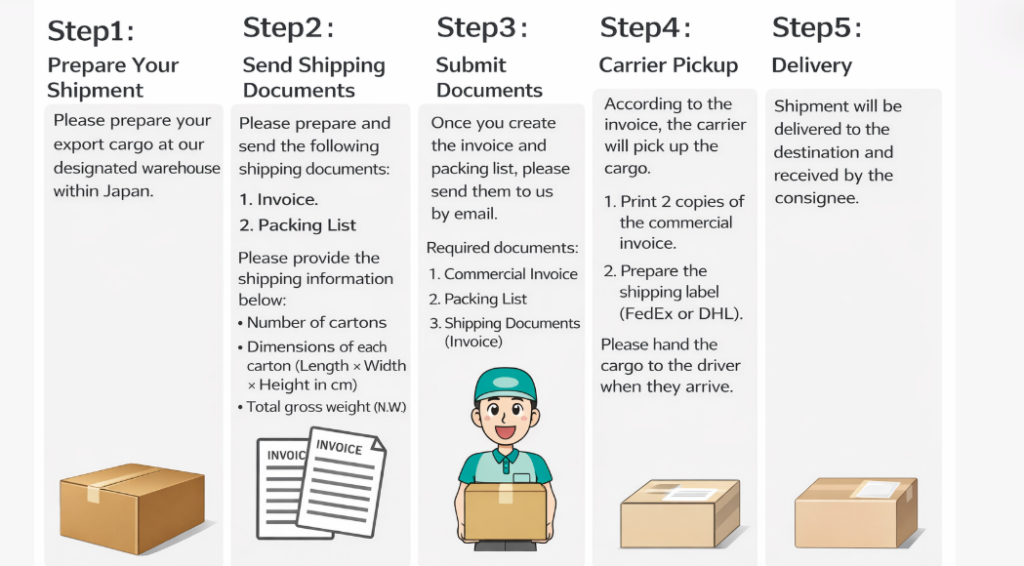
Step 1: Prepare the shipment
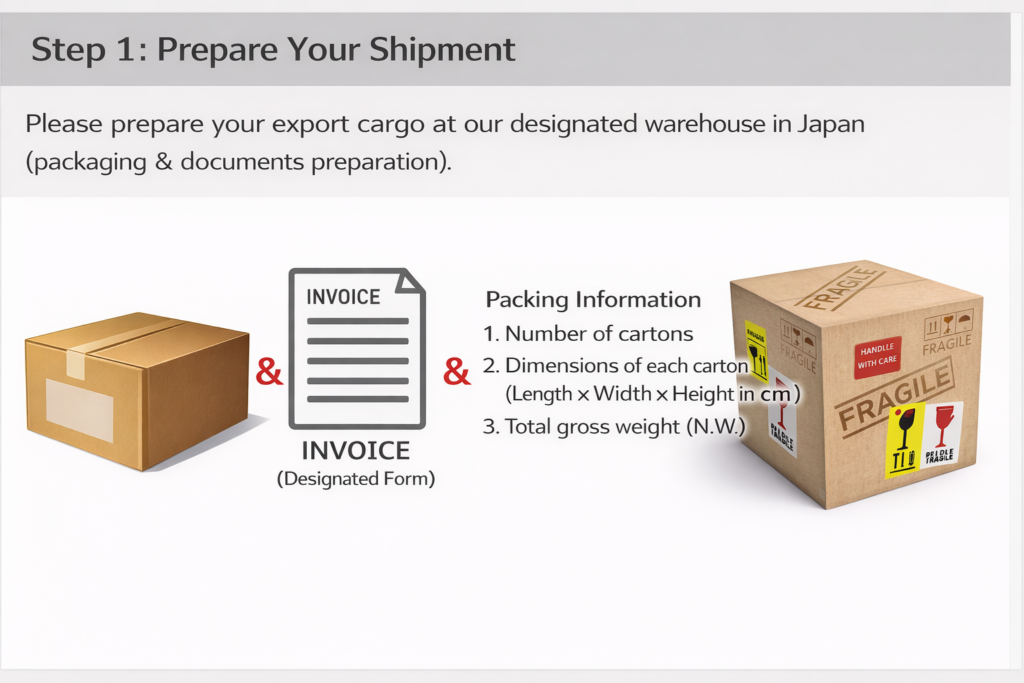
Prepare the shipment at the domestic pickup location (packing & document preparation).
Step 2: Email the shipment documents (invoice and packing information) to us.
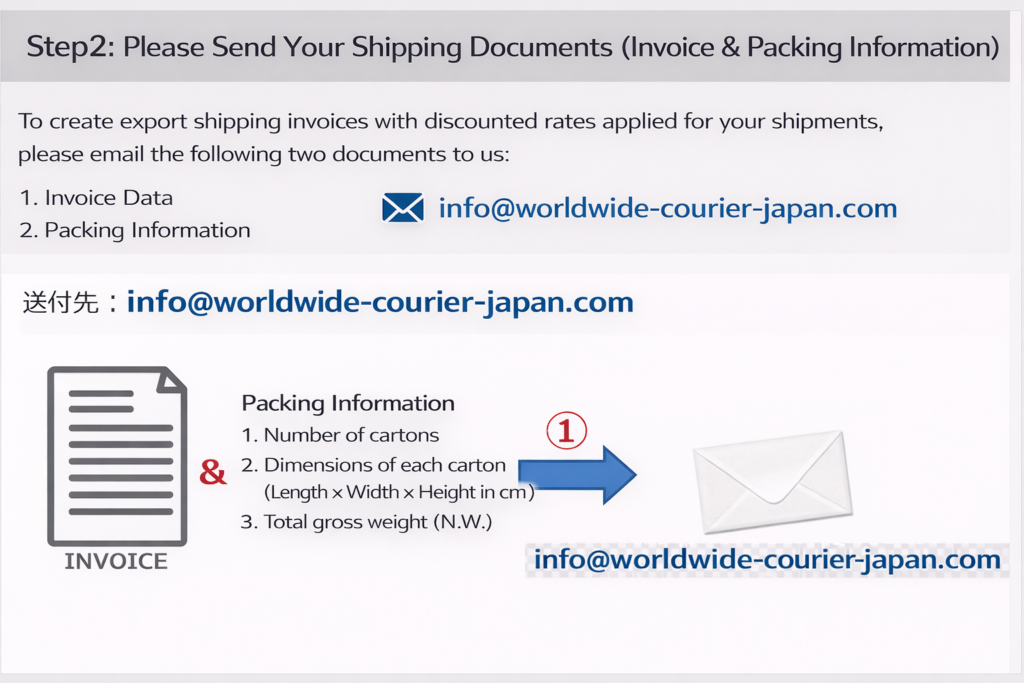
We will create the shipping documents using the special discounted rate provided for each customer. Please email the following two documents as attachments to our office.
1. “Invoice”
2. “Packing List”
Send to: info@worldwide-courier-japan.com
< Items that often end up missing on the invoice >
1. Postal code (shipper side)
2. Contact person name (shipper side)
3. Pickup phone number (shipper side)
※ The above three items are required to create the documents.
If any of this information is missing, we cannot create the documents, so please confirm in advance and submit your request accordingly.
< Required information on the packing list >
1. Total number of cartons
2. The three dimensions of each carton: length (cm), width (cm), height (cm)
3. Total weight (N.W.): total weight after packing
※ In some cases, the packing list lacks the above information. As it is required for document creation, please confirm in advance before requesting.
※ If you do not have a packing list, please confirm the above information with the shipper and share it with us.
< About “Chargeable Weight” used to determine shipping fees >
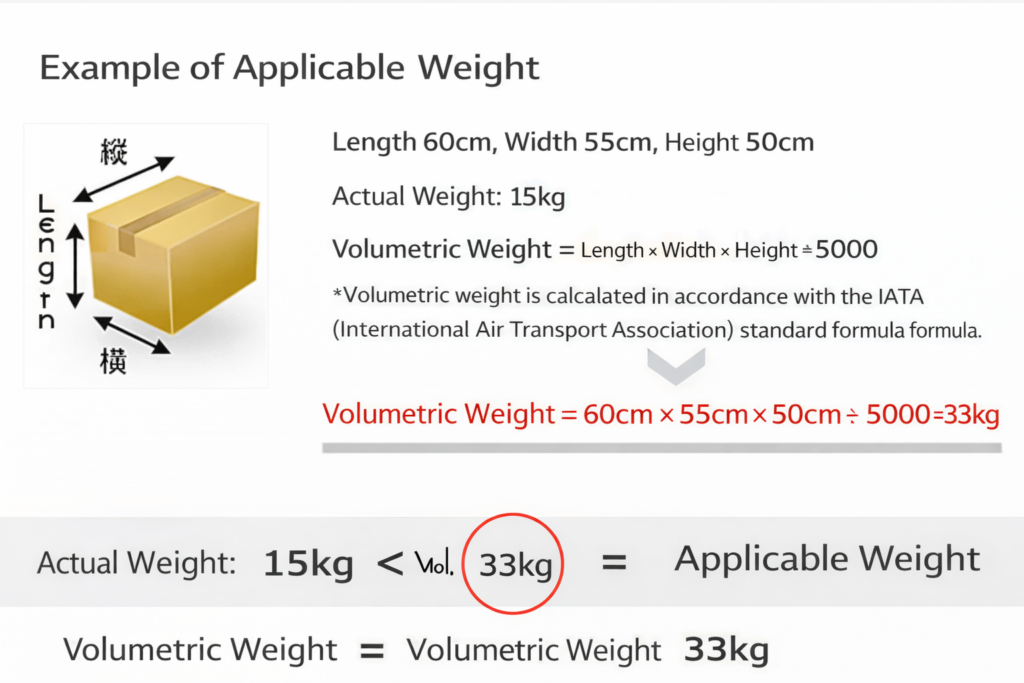
Based on IATA (International Air Transport Association) standards, the larger of the “actual weight after packing” and the “dimensional (volumetric) weight after packing” is adopted as the “chargeable weight.”
Step 3: We email two required documents for shipment (air waybill and invoice) to your shipper.
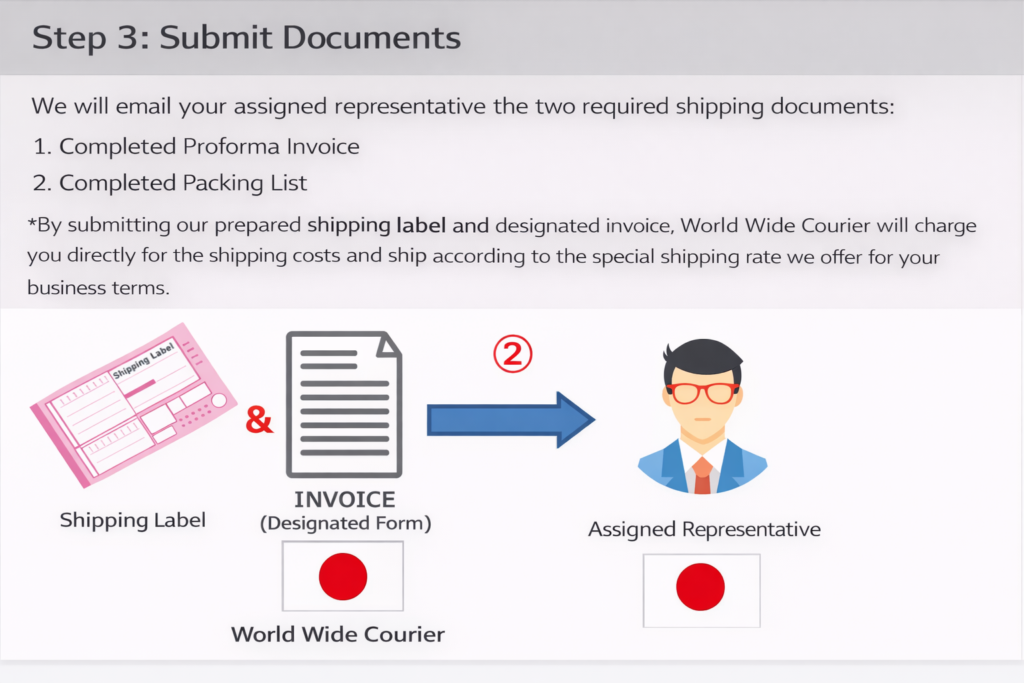
We will email two required documents for shipment (air waybill and invoice) to your 담당者.
1. Confirm any missing information in the “Invoice” and “Packing List” you provided.
2. Based on the above, we will prepare the “Air Waybill” and “Invoice (specified form)” on our side and email them to your 담당者.
※ By shipping using the “Air Waybill” and “Invoice (specified form)” created by us, the shipping charges will be billed to us. This enables you to ship using the applicable rate provided for each customer. Under your individual 거래 조건, we will invoice you for the shipping fees.
Step 4: The carrier picks up the shipment from the pickup location / domestic warehouse, and the shipment is dispatched
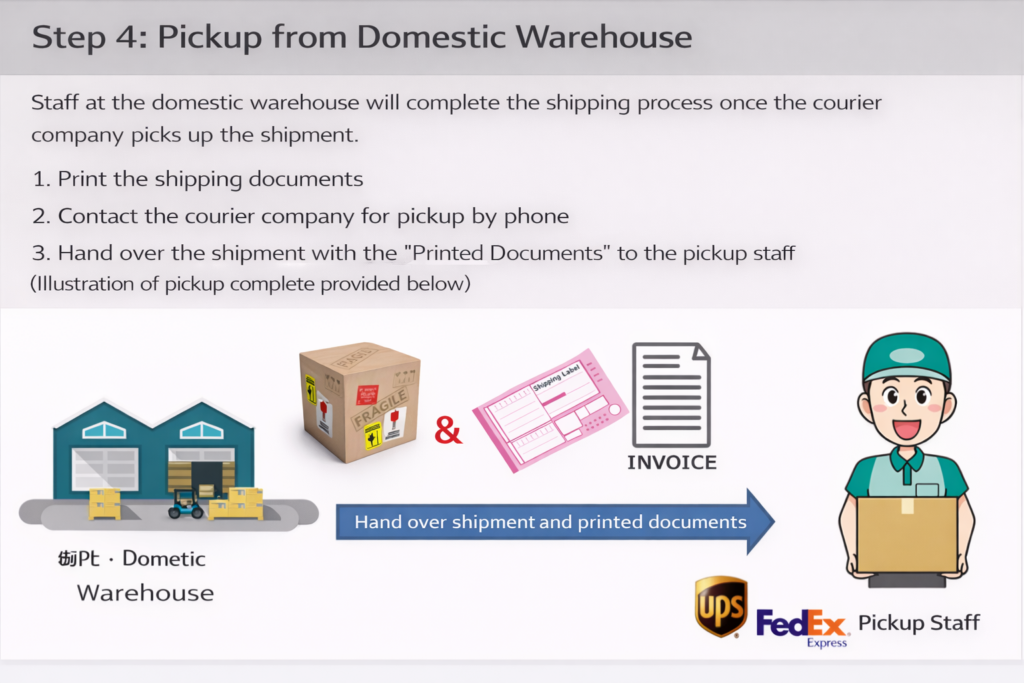
At the domestic pickup location:
1. Print the documents
2. Call the carrier to request pickup
3. Hand the “cargo” and the “two printed documents” to the pickup staff to complete dispatch
Step 5: Delivery and receipt of the cargo
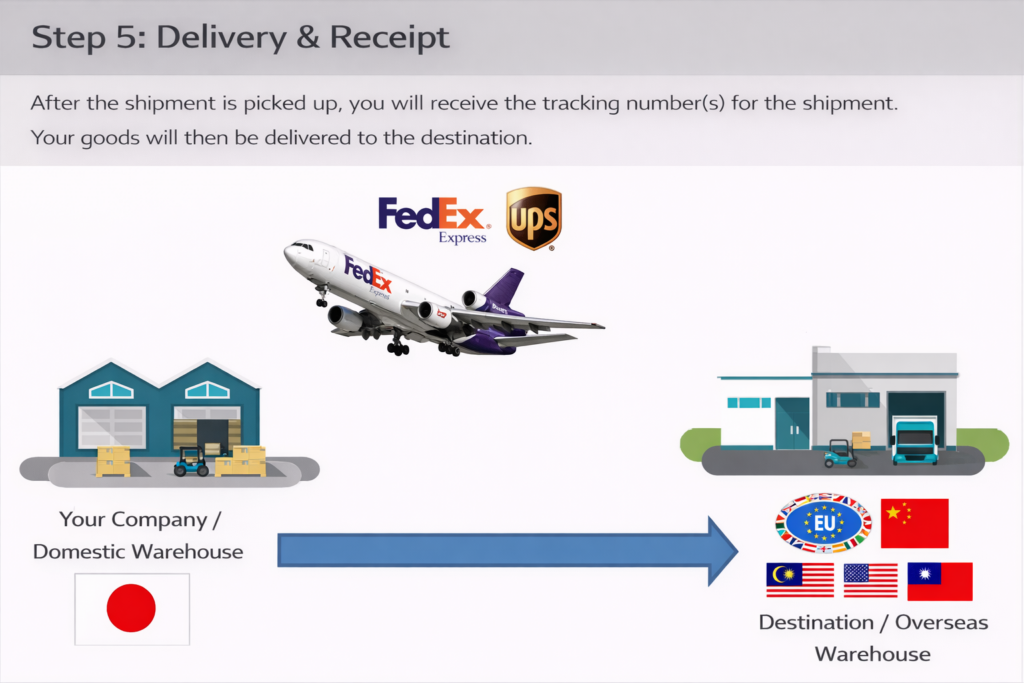
After dispatch, we will provide the tracking number. Your goods will then be delivered.
worldwide-courier provides low-cost delivery from Japan to the United States (U.S./USA) by air and sea. We support both exports and imports, so worldwide-courier reponce pls.
If you provide the information below, we can create the local shipping label.
Input format
◇ Pickup information (From)
1. Company name (or full name)
2. Contact person name
3. Postal code
4. Address
5. Phone number
※ This is the information for the location where the pickup will actually be made.
◇ Delivery address (To)
1. Company name (or full name) (※ Please 반드시 write in English.)
2. Contact person name (※ Please 반드시 write in English.)
3. Postal code
4. Address (※ Please 반드시 write in English.)
5. Phone number
◇ Packing information
1. Number of cartons
2. Total weight
3. Three dimensions of each carton (length, width, height in cm)
◇ Invoice information
・Product name (Please 반드시 write in English.)
・Unit price (Either currency is fine)
・Quantity
If you provide the above information, we can arrange the shipment. worldwide-courier offers low-cost delivery from Japan to the United States (U.S./USA) by air and sea. We support both exports and imports, so worldwide-courier reponce pls.
We look forward to your request.
Please let us know your current shipping frequency and shipping costs, if any.
Regarding your planned shipping date:
If you can also tell us around when you plan to ship, it will make the process smoother.
You can ship at the above rates.
For exports, we can create the shipping documents if you reply with the completed invoice as an attachment, or if you provide the information below.
◇ Pickup information (From)
1. Company name (or full name)
2. Contact person name
3. Postal code
4. Address
5. Phone number
※ This is the information for the location where the pickup will actually be made.
◇ Delivery address (To)
1. Company name (or full name) (※ Please 반드시 write in English.)
2. Contact person name (※ Please 반드시 write in English.)
3. Postal code
4. Address (※ Please 반드시 write in English.)
5. Phone number
◇ Packing information
1. Number of cartons
2. Total weight
3. Three dimensions of each carton (length, width, height in cm)
◇ Invoice information
・Product name (Please 반드시 write in English.)
・Unit price (Either currency is fine)
・Quantity
We will also guide you through the transaction flow.
Transaction flow (detailed version)
< Flow >
1. Please reply with the invoice.
2. If there are no issues with the information, we will book the pickup.
※ Pickup can be arranged as early as the next business day after your package is ready. (We typically book a window around 11:00–17:00.)
< Details: Export cargo transaction flow (Japan → destination country) >
The pickup process is as follows.
1. Please contact us after you finish packing your shipment.
2. Please prepare the invoice and packing information (number of cartons, weight, and three dimensions per carton).
※ 2-1. Shipper (Japan side): address, postal code, name, phone number, company name
2-2. Consignee (delivery destination): local address, postal code, name, phone number, company name
2-3. Product name and unit price
3. After we confirm (2) and there are no issues, we will arrange the pickup.
4. Within 1–2 business days, the carrier will come to your指定 location for pickup.
* We will email you the electronic data for the air waybill, so please hand the invoice and air waybill together with the package to the pickup staff.
5. Shipment is dispatched.
7. Local customs clearance processing (personal / commercial)
8. If there are no issues, the shipment clears customs.
9. Delivery is completed.
* Steps 5–8 typically take about 2–5 days to arrive if there are no issues.
* You will receive a tracking number as a shipment record.
Breakdown of Applicable Charges
1. Freight charges and fuel surcharge
2. Import duties, VAT/GST, customs clearance fees, and other local charges in the destination country, if applicable
The chargeable weight is calculated based on the larger of the actual weight and volumetric weight after packing.
Knowledge About Restricted and Prohibited Items
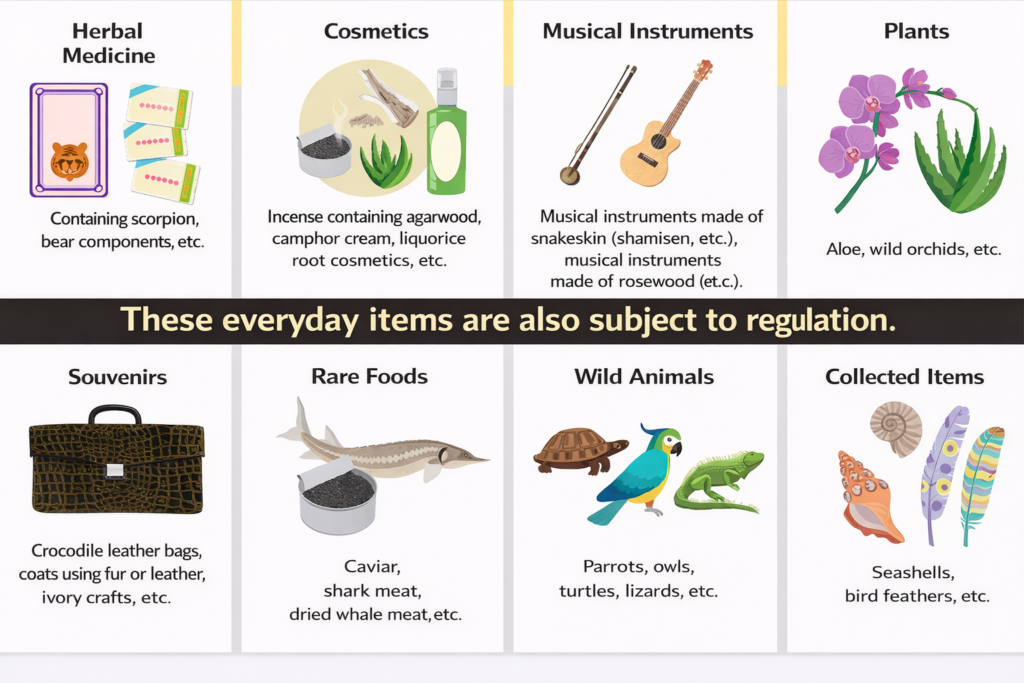
Certain items may be restricted or prohibited for international shipping depending on the destination country and carrier regulations. These may include dangerous goods, flammable materials, compressed gases, liquids, medicines, medical devices, firearms, tobacco products, perishables, seeds, plants, animals, chemicals, valuables, and CITES-regulated items.
In addition to the items listed above, other products may also be restricted depending on local import regulations. Some items may have shipping limitations, licensing requirements, or value restrictions.
Please contact us in advance if you are unsure whether your items can be shipped internationally from Japan.
That concludes our overview of international shipping from Japan to overseas destinations.
Practical Steps for International Shipping
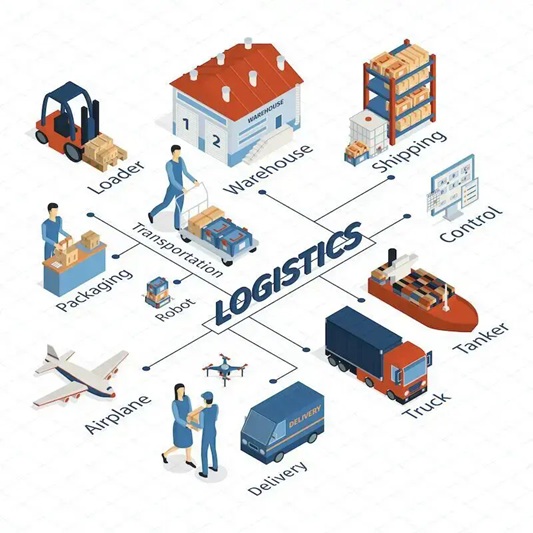
Executing a smooth overseas shipment begins long before the carrier picks up your goods. This section outlines the essential preparation tasks, required documents, and best practices to ensure compliance, minimize delays, and protect product integrity. Leveraging our experience as a comprehensive Japan-to-world logistics partner, Worldwide Courier Japan helps clients streamline the end-to-end process—from vendor readiness to final delivery—while maintaining cost efficiency and reliability across 200+ countries.
Shipment preparation and required documents
Effective shipment preparation starts with accurate product classification, labeling, and fulfillment readiness. Key steps include:
1) Final product verification: Confirm item descriptions, quantities, HS codes, and declared values to prevent customs hold-ups. For Japan-made goods, ensure alignment with destination country regulations and export controls.
2) Documentation checklist: Prepare commercial invoices detailing seller, buyer, currency, terms of sale, itemized descriptions, quantities, unit prices, and totals. Include packing lists, certificates of origin when required, and any specific regulatory documents (such as phytosanitary certificates for agricultural products or sanitary certificates for certain food items).
3) Packaging and labeling readiness: Ensure fragile items are properly labeled and protected, and that packaging corresponds to parcel or pallet dimensions for chosen transport mode. Attach handling labels (this side up, this end up), barcode labels, and destination information legibly.
4) Regulatory compliance review: Verify export licensing needs, restricted items, and country-specific import restrictions. Our team offers guidance on classification accuracy and documentation accuracy to minimize clearance delays.
5) Carrier and service selection: Choose the appropriate service level (air, sea, or courier), transit times, and insured value coverage. Consider consolidated shipments for cost efficiency and consult with our international logistics experts to optimize routing and documentation preparation.
6) Digital data hygiene: Maintain clean, accessible records in your shipment ledger or TMS, ensuring data consistency across invoices, packing lists, and manifests to avoid mismatches during customs checks.
Practical examples:
- For electronics destined to Europe, include CE technical documentation or a declaration of conformity when required by the destination country’s regulator.
- For consumer goods with potential rhythm hazards, provide clear hazard labeling and safety data sheets if applicable.
Benefits of thorough preparation with Worldwide Courier Japan:
- Faster customs clearance due to accurate HS codes and documentation.
- Lower risk of fines or delays from missing or incorrect paperwork.
- Seamless coordination across procurement, packaging, and shipping teams.
Packaging methods and temperature and humidity control
Protecting product integrity during global transit relies on robust packaging and environmental controls. Our guidelines emphasize:
1) Primary and secondary packaging strategy: Use sturdy primary packaging to shield contents from shocks and vibrations, with secondary outer packaging that resists moisture and compression. For fragile items, incorporate foam inserts, corner protectors, and zoned padding to reduce movement inside the carton.
2) Material choices: Select corrugated boxes with appropriate burst strength, moisture barriers for humidity-prone goods, and desiccants to manage moisture. For long-haul shipments, consider air-ride pallets and secure strapping to prevent shifting.
3) Temperature control: For perishable or temperature-sensitive products, employ insulated insulation materials, gel packs or phase-change materials, and temperature data loggers to monitor conditions throughout transit. Define acceptable temperature ranges and communicate these to the carrier to maintain compliance with destination requirements.
4) Humidity management: Use desiccants and moisture barrier films for products sensitive to humidity. Sealed polybags and moisture indicators help detect ingress of moisture early in the supply chain.
5) Tamper-evident and security considerations: Apply tamper-evident seals to reassure recipients and deter tampering. Use tamper-evident tape on all exterior seams where appropriate.
6) Sustainability and cost balance: While sturdier packaging improves protection, optimize packaging size to reduce dimensional weight charges. Leverage our vendor relationships to source cost-effective, compliant packaging materials without compromising protection.
Practical examples:
- Fresh or frozen foods require validated cold-chain packaging and continuous temperature monitoring, with documentation aligned to destination import rules.
- High-value electronics benefit from anti-static inner bags, foam inserts, and shock-absorbing cushioning to withstand long ocean or air freight routes.
Why choose our approach:
- End-to-end packaging planning integrated with shipping routes and carrier capabilities.
- Real-time temperature and humidity monitoring for high-risk goods.
- Clear guidance on material selection to balance protection, cost, and sustainability.
Introduction: Affordable international shipping to Japan from abroad

In today’s global marketplace, Japanese products attract buyers from around the world. For international buyers, navigating sourcing, shipping, and customs can be daunting. This section presents a practical path: affordable, reliable shipping solutions that connect overseas buyers with Japanese suppliers. By leveraging a comprehensive proxy buying service combined with end-to-end logistics, companies and individuals can access Japan’s high-quality goods at competitive costs while ensuring safe delivery.
Reasons why demand for Japanese products abroad will continue to grow
Japan’s reputation for quality, ingenuity, and design sustains strong international demand. Key drivers include:
– Robust brand equity across electronics, fashion, beauty, and household goods;
– Diverse product availability—from everyday essentials to limited-edition items and collectibles;
– Trusted reliability in product authenticity and craftsmanship;
– Efficient and transparent logistics networks supporting international trade.
As cross-border shopping becomes more convenient, buyers increasingly seek a one-stop solution that combines procurement, inspection, packaging, shipping, and customs support. A Japanese sourcing and shipping partner with global reach and competitive rates can capture growth from both individual consumers and businesses expanding into Japan.
Recommended transport partners that handle both imports to Japan and exports from Japan
For buyers seeking seamless cross-border flow, the following capabilities are essential: broad supplier access in Japan; cost-efficient, reliable shipping (air and sea); robust customs expertise; and a one-stop service model including procurement, inspection, packing, and delivery to door or port. Leading partners offer:
– Buy Japanese products from Japan through a proxy buying service with access to major Japanese retailers and marketplaces, including Amazon.co.jp, Rakuten, Yahoo! Shopping, Mercari, Uniqlo, BicCamera, ZOZOTOWN, Yahoo Auctions, Lohaco, and more. (Requests for other sources are welcome.)
– End-to-end logistics for international shipments to 200+ destinations, with flexible options for individuals and corporate clients.
– Thorough inspection, protection against damage, and compliant packaging designed for long-distance transit.
– Import and export capabilities, enabling both international buyers to bring goods into Japan and Japanese exporters to reach overseas markets efficiently.
By consolidating purchasing, quality checks, packing, shipping, and brokerage, these partners can significantly reduce costs, shorten lead times, and simplify compliance for both sides of the global trade. If you need a tailored quote or to discuss specific product categories, reach out via the contact channel provided by the service provider.
Cost Estimates and Savings Strategies

Understanding the pricing structure for international shipments is essential for businesses and individuals seeking to optimize their logistics costs. This chapter outlines the key components that determine shipping charges, from base rates to surcharges, and then provides practical, actionable plans to reduce expenses without compromising delivery speed or safety. By dissecting each cost element and offering tiered shipping options, readers can tailor their approach to their budgets, timelines, and service requirements while maintaining reliable, compliant, and customer-friendly forwarding solutions.
Components of International Freight Costs
Shipping charges are influenced by multiple factors that combine to form the total quote. The primary elements include base rate, weight and dimensional weight, service level (air, sea, or economy options), distance, and destination country regulations. Additionally, ancillary charges such as handling, fuel surcharges, insurance, documentation, and port or airport fees can add to the final price. For both individuals and businesses, the most impactful variables are weight (actual vs. dimensional) and the chosen service speed. Understanding these helps in forecasting costs and identifying optimization opportunities.
Key cost drivers to examine:
- Weight: Heavier items incur higher charges; dimensional weight may apply if the package is bulky relative to its weight.
- Service level: Express or priority services command premium rates; standard or economy options reduce costs but extend transit times.
- Origin-destination pair: Some routes have higher handling fees or longer transit times, affecting pricing.
- Packaging and protection: Durable, compliant packaging may incur upfront costs but can prevent damages and costly returns or claims.
- Insurance: Optional coverage adds cost but protects value-bearing shipments.
- Customs and duties arrangements: DDP (Delivered Duty Paid) vs. DDU (Delivered Duty Unpaid) impact the consumer’s or sender’s duties and thus pricing.
Proactive cost assessment involves requesting itemized quotes, comparing carriers, and considering total landed cost rather than upfront freight alone. A trusted forwarder with experience in cross-border e-commerce can provide accurate estimates that reflect real-world conditions, including potential delays or required documentation.
Cost-Reduction Shipping Plans
Practical strategies can significantly lower shipping spend while ensuring timely delivery and safe handling. The following plans prioritize volume, consolidation, and service alignment with the nature of the goods being shipped.
- Consolidated shipments: Combine multiple orders into a single shipment to leverage lower per-unit costs and reduce handling fees. This is especially effective for small items destined for the same recipient or address.
- Choice of service tier: Opt for economy or standard services when speed is not mission-critical. For high-value items, balance slower transit times with robust packaging and insurance to avoid claims that negate savings.
- Dimensional weight awareness: Optimize packaging dimensions to minimize dimensional weight. Use compact boxes and efficient padding to keep both weight and volume down.
- Packaging optimization: Invest in lightweight, protective packaging that meets regulatory standards. Proper packaging reduces damage risk and may lower insurance premiums.
- Regional hubs and routes: Select routes with fewer transfers and favorable handling facilities. Direct or near-direct routes can reduce transit time and the likelihood of delays or additional charges.
- Insurance policy alignment: Evaluate the necessary level of coverage. Over-insurance inflates costs, while under-insurance raises risk; choose a policy that matches item value and risk profile.
- Documentation accuracy: Prepare precise commercial invoices, packing lists, and certificates to avoid customs delays and penalties that incur additional charges.
- Volume-based pricing: For businesses, negotiate volume discounts or contract rates with carriers, leveraging steadier shipments and higher annual turnover.
- Cross-border e-commerce support: Leverage a one-stop forwarding partner who can handle procurement, inspection, packing, and logistics under a single umbrella, often reducing overall costs through synergies.
When planning shipments, simulate different scenarios—varying weights, sizes, service levels, and destinations—to identify the most cost-effective combination for each order. By combining smart packaging, route selection, and service alignment, clients can achieve meaningful savings while maintaining reliability and speed where it matters most.
About International Shipping Rates from Japan
◇ Shipping rate table (price per kg)
Japan → United States (U.S./North America/Central America)
※ UPS fastest service level with tracking number. ※
※ We can also handle EMS, International ePacket, air mail, SAL, and sea freight via Japan Post—please let us know if you prefer these options..
※ UPS fastest service level with tracking number ※
【United States (U.S./North America/Central America) Export Preferred Rates】
・1kg :4,030円
1.5kg :4,451円
2kg :4,963円
2.5kg :5,409円
3kg :5,889円
3.5kg :6,271円
4kg :6,701円
4.5kg :7,164円
5kg :7,580円
5.5kg :7,674円
6kg :7,878円
6.5kg :8,160円
7kg :8,317円
7.5kg :8,601円
8kg :8,727円
8.5kg :8,867円
9kg :9,087円
9.5kg :9,306円
10kg :9,464円
10.5 :18,790円
11kg : 19,257円
11.5kg:19,526円
12kg : 19,760円
12.5kg: 20,094円
13kg : 20,431円
13.5kg: 20,798円
14kg : 21,132円
14.5kg: 21,432円
15kg : 21,904円
15.5kg: 22,204円
16kg : 22,571円
16.5kg: 22,877円
17kg : 23,242円
17.5kg: 23,578円
18kg : 23,946円
18.5kg: 24,183円
19kg : 24,449円
19.5kg: 24,851円
20kg : 25,388円
・21-49kg :900円/ per 1kg
・50-99kg :710円/ per 1kg
・100-299kg:620円/ per 1kg
・300-499kg:615円/ per 1kg
・500-999kg:610円/ per 1kg
・1000-5000kg:605円/ per 1kg
Canada Export Shipping Rates (Discount Contract Rates)
The following are our special discounted shipping rates for exporting parcels from Japan to Canada. These rates are designed for international shipments using reliable courier services with secure customs clearance.
| Weight | Shipping Cost |
|---|---|
| 1 kg | 4,030 JPY |
| 1.5 kg | 4,451 JPY |
| 2 kg | 4,963 JPY |
| 2.5 kg | 5,409 JPY |
| 3 kg | 5,889 JPY |
| 3.5 kg | 6,271 JPY |
| 4 kg | 6,701 JPY |
| 4.5 kg | 7,164 JPY |
| 5 kg | 7,580 JPY |
| 5.5 kg | 7,674 JPY |
| 6 kg | 7,878 JPY |
| 6.5 kg | 8,160 JPY |
| 7 kg | 8,317 JPY |
| 7.5 kg | 8,601 JPY |
| 8 kg | 8,727 JPY |
| 8.5 kg | 8,867 JPY |
| 9 kg | 9,087 JPY |
| 9.5 kg | 9,306 JPY |
| 10 kg | 9,464 JPY |
| 10.5 kg | 18,790 JPY |
| 11 kg | 19,257 JPY |
| 11.5 kg | 19,526 JPY |
| 12 kg | 19,760 JPY |
| 12.5 kg | 20,094 JPY |
| 13 kg | 20,431 JPY |
| 13.5 kg | 20,798 JPY |
| 14 kg | 21,132 JPY |
| 14.5 kg | 21,432 JPY |
| 15 kg | 21,904 JPY |
| 15.5 kg | 22,204 JPY |
| 16 kg | 22,571 JPY |
| 16.5 kg | 22,877 JPY |
| 17 kg | 23,242 JPY |
| 17.5 kg | 23,578 JPY |
| 18 kg | 23,946 JPY |
| 18.5 kg | 24,183 JPY |
| 19 kg | 24,449 JPY |
| 19.5 kg | 24,851 JPY |
| 20 kg | 25,388 JPY |
Bulk Shipping Rates
| Weight Range | Rate per kg |
|---|---|
| 21 – 49 kg | 900 JPY / kg |
| 50 – 99 kg | 710 JPY / kg |
| 100 – 299 kg | 620 JPY / kg |
| 300 – 499 kg | 615 JPY / kg |
| 500 – 999 kg | 610 JPY / kg |
| 1,000 – 5,000 kg | 605 JPY / kg |
These international shipping rates allow businesses and individuals to ship goods from Japan to Canada efficiently and cost-effectively. Large-volume shipments receive significantly reduced per-kilogram rates, making them ideal for e-commerce exports, bulk cargo, and commercial logistics.
Discount Export Shipping Rates from Japan (Asia & International Cargo)
Below are our special discounted international cargo shipping rates for exporting goods from Japan. These bulk shipping prices are ideal for businesses, e-commerce sellers, and logistics companies shipping large cargo volumes overseas.
Hong Kong Export Shipping Rates
| 21 – 50 kg | 750 JPY / kg |
| 50 – 100 kg | 550 JPY / kg |
| 100 – 299 kg | 400 JPY / kg |
| 300 – 999 kg | 380 JPY / kg |
| 1000 – 2000 kg | 350 JPY / kg |
| Over 2000 kg | 320 JPY / kg |
South Korea Export Shipping Rates
| 21 – 50 kg | 850 JPY / kg |
| 50 – 100 kg | 650 JPY / kg |
| 100 – 299 kg | 520 JPY / kg |
| 300 – 999 kg | 510 JPY / kg |
| 1000 – 2000 kg | 500 JPY / kg |
| Over 2000 kg | 490 JPY / kg |
Taiwan Export Shipping Rates
| 21 – 50 kg | 850 JPY / kg |
| 50 – 100 kg | 650 JPY / kg |
| 100 – 299 kg | 520 JPY / kg |
| 300 – 999 kg | 510 JPY / kg |
| 1000 – 2000 kg | 500 JPY / kg |
| Over 2000 kg | 490 JPY / kg |
China (Northern Region: Shanghai, Zhejiang etc.) Export Shipping Rates
| 21 – 50 kg | 850 JPY / kg |
| 50 – 100 kg | 650 JPY / kg |
| 100 – 299 kg | 520 JPY / kg |
| 300 – 999 kg | 510 JPY / kg |
| 1000 – 2000 kg | 500 JPY / kg |
| Over 2000 kg | 490 JPY / kg |
China (Southern Region: Guangdong, Fujian etc.) Export Shipping Rates
| 21 – 50 kg | 1350 JPY / kg |
| 50 – 100 kg | 1150 JPY / kg |
| 100 – 299 kg | 980 JPY / kg |
| 300 – 999 kg | 970 JPY / kg |
| 1000 – 2000 kg | 960 JPY / kg |
| Over 2000 kg | 950 JPY / kg |
Macau Export Shipping Rates
| 21 – 50 kg | 850 JPY / kg |
| 50 – 100 kg | 650 JPY / kg |
| 100 – 299 kg | 520 JPY / kg |
| 300 – 999 kg | 510 JPY / kg |
| 1000 – 2000 kg | 500 JPY / kg |
| Over 2000 kg | 490 JPY / kg |
Southeast Asia Export Shipping Rates (Malaysia / Vietnam / Philippines / Singapore / Thailand)
| 21 – 49 kg | 600 JPY / kg |
| 50 – 99 kg | 480 JPY / kg |
| 100 – 299 kg | 360 JPY / kg |
| 300 – 499 kg | 358 JPY / kg |
| 500 – 999 kg | 350 JPY / kg |
| 1000 – 2000 kg | 348 JPY / kg |
India & Australia Export Shipping Rates
| 21 – 49 kg | 1000 JPY / kg |
| 50 – 99 kg | 890 JPY / kg |
| 100 – 299 kg | 750 JPY / kg |
| 300 – 499 kg | 730 JPY / kg |
| 500 – 999 kg | 720 JPY / kg |
| 1000 – 2000 kg | 690 JPY / kg |
Europe Export Shipping Rates (Spain / Germany / France / Italy)
| 21 – 49 kg | 1200 JPY / kg |
| 50 – 99 kg | 990 JPY / kg |
| 100 – 299 kg | 850 JPY / kg |
| 300 – 499 kg | 830 JPY / kg |
| 500 – 999 kg | 820 JPY / kg |
| 1000 – 2000 kg | 790 JPY / kg |
These discounted cargo shipping rates from Japan are ideal for bulk shipments, international trade, and cross-border e-commerce. Businesses shipping larger volumes benefit from significantly reduced per-kilogram costs, making global logistics more efficient and affordable.
The above rates are unit prices per kilogram. Please refer to the examples on the right for the shipping cost rate by weight.
In addition to the above shipping fees, a fuel surcharge will apply. Monthly or weekly fuel surcharge fees are charged depending on the carrier you use.
Any duties, import taxes, etc. incurred during local customs clearance will be billed by the carrier to the consignee.
How it works
We offer good service.worldwide-courier provides international logistics and international shipping (air freight) services that arrange shipping on behalf of trading businesses.
The United States・We support imports and exports not only with China and Hong Kong, but also Korea, the U.S., Europe, Southeast Asia, India, Africa, and many other countries.
By using major couriers (FedEx/UPS/DHL), we provide stable and speedy delivery, and with the overwhelmingly low shipping rates offered by worldwide-courier, we help reduce your existing delivery costs and overall procurement costs.
Step 1: Prepare the shipment
Prepare the shipment at the domestic pickup location (packing & document preparation).
Step 2: Email the shipment documents (invoice and packing information) to us.
We will create the shipping documents using the special discounted rate provided for each customer. Please email the following two documents as attachments to our office.
1. “Invoice”
2. “Packing List”
Send to: info@worldwide-courier-japan.com
< Items that often end up missing on the invoice >
1. Postal code (shipper side)
2. Contact person name (shipper side)
3. Pickup phone number (shipper side)
※ The above three items are required to create the documents.
If any of this information is missing, we cannot create the documents, so please confirm in advance and submit your request accordingly.
< Required information on the packing list >
1. Total number of cartons
2. The three dimensions of each carton: length (cm), width (cm), height (cm)
3. Total weight (N.W.): total weight after packing
※ In some cases, the packing list lacks the above information. As it is required for document creation, please confirm in advance before requesting.
※ If you do not have a packing list, please confirm the above information with the shipper and share it with us.
< About “Chargeable Weight” used to determine shipping fees >
Based on IATA (International Air Transport Association) standards, the larger of the “actual weight after packing” and the “dimensional (volumetric) weight after packing” is adopted as the “chargeable weight.”
Step 3: We email two required documents for shipment (air waybill and invoice) to your shipper.
We will email two required documents for shipment (air waybill and invoice) to your 담당者.
1. Confirm any missing information in the “Invoice” and “Packing List” you provided.
2. Based on the above, we will prepare the “Air Waybill” and “Invoice (specified form)” on our side and email them to your 담당者.
※ By shipping using the “Air Waybill” and “Invoice (specified form)” created by us, the shipping charges will be billed to us. This enables you to ship using the applicable rate provided for each customer. Under your individual 거래 조건, we will invoice you for the shipping fees.
Step 4: The carrier picks up the shipment from the pickup location / domestic warehouse, and the shipment is dispatched
At the domestic pickup location:
1. Print the documents
2. Call the carrier to request pickup
3. Hand the “cargo” and the “two printed documents” to the pickup staff to complete dispatch
Step 5: Delivery and receipt of the cargo
After dispatch, we will provide the tracking number. Your goods will then be delivered.
worldwide-courier provides low-cost delivery from Japan to the United States (U.S./USA) by air and sea. We support both exports and imports, so worldwide-courier reponce pls.
If you provide the information below, we can create the local shipping label.
Input format
◇ Pickup information (From)
1. Company name (or full name)
2. Contact person name
3. Postal code
4. Address
5. Phone number
※ This is the information for the location where the pickup will actually be made.
◇ Delivery address (To)
1. Company name (or full name) (※ Please 반드시 write in English.)
2. Contact person name (※ Please 반드시 write in English.)
3. Postal code
4. Address (※ Please 반드시 write in English.)
5. Phone number
◇ Packing information
1. Number of cartons
2. Total weight
3. Three dimensions of each carton (length, width, height in cm)
◇ Invoice information
・Product name (Please 반드시 write in English.)
・Unit price (Either currency is fine)
・Quantity
If you provide the above information, we can arrange the shipment. worldwide-courier offers low-cost delivery from Japan to the United States (U.S./USA) by air and sea. We support both exports and imports, so worldwide-courier reponce pls.
We look forward to your request.
Please let us know your current shipping frequency and shipping costs, if any.
Regarding your planned shipping date:
If you can also tell us around when you plan to ship, it will make the process smoother.
You can ship at the above rates.
For exports, we can create the shipping documents if you reply with the completed invoice as an attachment, or if you provide the information below.
◇ Pickup information (From)
1. Company name (or full name)
2. Contact person name
3. Postal code
4. Address
5. Phone number
※ This is the information for the location where the pickup will actually be made.
◇ Delivery address (To)
1. Company name (or full name) (※ Please 반드시 write in English.)
2. Contact person name (※ Please 반드시 write in English.)
3. Postal code
4. Address (※ Please 반드시 write in English.)
5. Phone number
◇ Packing information
1. Number of cartons
2. Total weight
3. Three dimensions of each carton (length, width, height in cm)
◇ Invoice information
・Product name (Please 반드시 write in English.)
・Unit price (Either currency is fine)
・Quantity
We will also guide you through the transaction flow.
Transaction flow (detailed version)
< Flow >
1. Please reply with the invoice.
2. If there are no issues with the information, we will book the pickup.
※ Pickup can be arranged as early as the next business day after your package is ready. (We typically book a window around 11:00–17:00.)
< Details: Export cargo transaction flow (Japan → destination country) >
The pickup process is as follows.
1. Please contact us after you finish packing your shipment.
2. Please prepare the invoice and packing information (number of cartons, weight, and three dimensions per carton).
※ 2-1. Shipper (Japan side): address, postal code, name, phone number, company name
2-2. Consignee (delivery destination): local address, postal code, name, phone number, company name
2-3. Product name and unit price
3. After we confirm (2) and there are no issues, we will arrange the pickup.
4. Within 1–2 business days, the carrier will come to your指定 location for pickup.
* We will email you the electronic data for the air waybill, so please hand the invoice and air waybill together with the package to the pickup staff.
5. Shipment is dispatched.
7. Local customs clearance processing (personal / commercial)
8. If there are no issues, the shipment clears customs.
9. Delivery is completed.
* Steps 5–8 typically take about 2–5 days to arrive if there are no issues.
* You will receive a tracking number as a shipment record.
Breakdown of Applicable Charges
1. Freight charges and fuel surcharge
2. Import duties, VAT/GST, customs clearance fees, and other local charges in the destination country, if applicable
The chargeable weight is calculated based on the larger of the actual weight and volumetric weight after packing.
Knowledge About Restricted and Prohibited Items
Certain items may be restricted or prohibited for international shipping depending on the destination country and carrier regulations. These may include dangerous goods, flammable materials, compressed gases, liquids, medicines, medical devices, firearms, tobacco products, perishables, seeds, plants, animals, chemicals, valuables, and CITES-regulated items.
In addition to the items listed above, other products may also be restricted depending on local import regulations. Some items may have shipping limitations, licensing requirements, or value restrictions.
Please contact us in advance if you are unsure whether your items can be shipped internationally from Japan.
That concludes our overview of international shipping from Japan to overseas destinations.
Strategic Guide to Choosing Affordable and Reliable Global Freight Forwarding Partners

In today’s cross-border trade landscape, selecting the right international shipping代理 can dramatically impact cost, speed, and customer satisfaction. This chapter outlines practical selection criteria, evaluation tactics, and the hallmark traits of reputable forwarders. The goal is to help exporters, retailers, and individual buyers secure cost-effective, dependable services without sacrificing compliance or service quality.
Key Selection Points and How to Compare
1) Pricing structure and total landed cost: Look beyond base shipping rates. Request a transparent breakdown covering origin charges, fuel surcharges, handling fees, duties/taxes, and any hidden costs. Compare total landed costs for similar shipment profiles (weight, dimensions, destination).
2) Service scope and integration: Confirm end-to-end capabilities—purchase代理 (if needed), consolidation, packaging, labeling, export/import clearance, and final delivery. A one-stop solution minimizes handoffs and delays.
3) Transit times and reliability: Obtain typical transit windows and historical on-time performance. Consider carrier mix (air vs. sea) and seasonal demand impacts. Ask for service level commitments (SLAs) and remedies for delays.
4) Compliance and risk management: Ensure expertise in customs regulations, product restrictions, and documentation. A trusted forwarder should proactively mitigate risks and provide clear guidance on prohibited items, HS codes, and required permits.
5) Insurance and damage protection: Verify cargo insurance options, coverage limits, and claims processes. For high-value items (electronics, luxury goods, collectibles), assessmargins for secure packaging and coverage adequacy.
6) Tracking and visibility: Favor providers offering real-time tracking, proactive status updates, and accessible customer support. Visibility reduces anxiety for high-volume or time-sensitive shipments.
7) Customer support and account management: Assess responsiveness, multilingual assistance, and dedicated account managers for business clients. Strong support minimizes downtime during customs holds or routing changes.
8) Reliability and scale: Consider the carrier network, regional reach, and capacity to handle peak seasons or large orders. A reputable forwarder should demonstrate stable operations across multiple markets and years of experience.
9) Sustainability and ethics: If important to your brand, review environmental practices, packaging optimization, and responsible shipping options.
10) References and track record: Request case studies or testimonials, focusing on similar product categories and destinations. Verify longevity of client relationships and, if possible, performance metrics.
Features of Recommended Forwarding Companies
1) Comprehensive purchase-to-delivery capabilities: A standout forwarder can manage procurement coordination, quality inspection, consolidations, compliant packaging, international shipping (air and ocean), customs clearance, and final mile delivery. This reduces fragmentation and errors.
2) Highly competitive pricing with transparent charges: Leading firms leverage their scale to minimize intermediate costs, offering predictable pricing models and optional services (insurance, packaging upgrades) without surprise fees.
3) Global network and diverse carrier mix: A proven footprint in 200+ countries or more, with access to major airlines, liners, and regional partners—ensuring flexible routing and reliable timing even in busy lanes.
4) Expedited handling for business orders: For B2B clients or large orders, capabilities like scheduled consolidation, priority handling, and dedicated operational teams help maximize efficiency and lead times.
5) Rigorous compliance expertise: The best forwarders stay up to date with evolving customs regulations, product classifications, and trade controls, offering proactive guidance to prevent delays and penalties.
6) Robust risk management: Comprehensive insurance options, damage-free packaging standards, and a clear, speedy claims process contribute to peace of mind when shipping valuable or fragile goods.
7) Transparent tracking and proactive communication: User-friendly portals, real-time updates, and proactive alerts enable customers to monitor shipments and plan accordingly.
8) Customer-centric support for both individuals and organizations: Multilingual, knowledgeable staff, and scalable support for startups, SMEs, and large enterprises foster trust and repeat business.
9) Sustainability-minded practices: Efficient packaging, optimized routes, and carbon-conscious options align with responsible business operations and can appeal to sustainability-focused customers.
10) Positive references and verifiable performance: Consistent performance, long-term client relationships, and clearly demonstrated capabilities across product types reassure prospective clients.
Customs Strategies and Troubleshooting

Effective customs handling is essential for international shipments. By understanding tariffs, taxes, and regulatory requirements, businesses and individuals can minimize delays, reduce costs, and ensure smooth delivery from Japan to global destinations. This section outlines how duties and value-added taxes are calculated, who is responsible for payments, and practical steps to prevent common customs issues. It also provides actionable approaches for handling quality concerns and delays, so buyers and sellers stay informed and prepared throughout the import/export process.
Tariffs and VAT: How they are calculated and who pays
Tariffs, duties, and value-added tax (VAT) or Goods and Services Tax (GST) are determined by the destination country’s customs authorities. Key factors include the product category, its HS code, declared value, and country of origin. Typical considerations:
– Classification: Correctly identifying the harmonized system (HS) code is crucial. Misclassification can cause delays, fines, or incorrect duty assessments. Our team provides HS code guidance and pre-shipment classification checks to mitigate risk.
– Valuation: Customs use the declared value to calculate duties and taxes. Including freight and insurance in the value may be required in some jurisdictions. We help ensure transparent, accurate invoicing and supportive documentation.
-Origin and preferential programs: Some countries offer reduced or eliminated duties under free trade agreements or special schemes. Proper origin certificates and documentation can unlock lower rates.
-Tax responsibility: Incoterms define who pays duties and taxes. For consumer shipments, duties are usually collected on import; for business shipments, prepayment or post-clearance options may apply. We tailor the payment flow to minimize post-clearance friction.
Practical tips:
- Provide precise product descriptions, accurate values, and correct HS codes on all customs documents.
- Coordinate with the consignee to ensure timely payment of duties or to arrange prepaid options when advantageous.
- Maintain complete, auditable documentation (commercial invoices, packing lists, origin certificates) to expedite clearance.
- Anticipate country-specific restrictions (dual-use items, electronics, food ingredients) and prepare necessary permits or licenses in advance.
As a Japan-based international logistics provider, we leverage our knowledge of global customs requirements to optimize routing, minimize duty exposure, and support compliant, fast clearance for a wide range of products—from electronics and fashion to everyday consumer goods.
Quality issues and delay mitigation
Quality problems and delivery delays are among the top causes of customer dissatisfaction in cross-border shipments. Proactive prevention and rapid response are essential. The following practices help reduce risk and resolve issues efficiently:
Preventive measures:
- Pre-shipment inspection: Conduct rigorous checks for product condition, packaging integrity, and compliance with destination regulations. We offer item-by-item inspection and standardized reporting to identify potential issues before departure.
- Secure packaging: Use damage-proof materials and temperature-appropriate packaging for sensitive items. Our packaging standards include shock protection, humidity control, and tamper-evident seals where appropriate.
- Clear labeling: Ensure all items are labeled with accurate descriptions, quantities, HS codes, and country of origin to avoid clearance delays.
- Documentation accuracy: Prepare accurate commercial invoices, packing lists, and certificates of origin to support swift customs processing.
- Carrier collaboration: Align shipping mode, transit times, and service levels with the destination’s requirements to prevent bottlenecks at midpoints or hubs.
Handling issues after shipment:
- Prompt communication: If a claim is needed, document the issue with photos, serial numbers, and condition notes. Notify the recipient and carrier promptly.
- Evidence-based claims: Compile purchase receipts, product specs, warranty terms, and any prior inspection reports to support fault assessment.
- Defined remedy options: Agree on replacement, repair, partial refund, or damaged goods credit, depending on the severity and our contractual terms.
- Timely escalation: Elevate complex cases to cross-functional teams (logistics, compliance, supplier management) to secure a swift resolution and minimize disruption to the buyer and seller.
By combining robust pre-shipment checks with clear communication and structured claims processes, we reduce the impact of quality issues and delays on international shipments from Japan, helping global customers receive reliable, compliant products on time.
Real-World Case Studies and Frequently Asked Questions

In this section, we present concrete shipping scenarios to illustrate how our cross-border logistics solutions work in practice. We highlight cost structures, timelines, and strategies that maximize value for both individual buyers and businesses. We also answer common questions to address practical concerns about shipping Japanese products overseas, ensuring a smooth, transparent, and reliable process from purchase to delivery.
Actual Freight Charge Case Study
Case study overview: A small-to-medium enterprise sources a batch of 250 units of consumer electronics from a Japanese retailer for distribution in Europe. The client requires consolidated shipping to reduce costs, with strict protection against damage and timely delivery to meet promotional windows. Our approach combines domestic sourcing, quality inspection, protective packing, and multimodal transport (air for faster delivery, with sea options for cost efficiency when timelines allow). We provide a complete breakdown: itemized product price, procurement fees, inspection and repackaging, insurance, freight charges, handling at origin and destination, and customs duties estimation. The result demonstrates a total landed cost that remains competitive due to our procurement leverage, absence of middlemen, and optimized routing. Key takeaways: (1) procurement strength across multiple sources enables favorable pricing; (2) consolidated shipments dramatically cut per-unit costs; (3) proactive packaging and labeling minimize rework and delays at customs. For readers evaluating similar orders, we outline the decision criteria: order size, product fragility, required lead time, insurance requirements, and destination country import regulations. By aligning these factors with our end-to-end service, customers can achieve faster, safer, and more cost-effective overseas delivery.
Frequently Asked Questions and Answers
Q1: Can you help me buy products from Japanese retailers like Amazon.co.jp, Rakuten, or Yahoo Shopping and ship them overseas? A1: Yes. We provide a seamless proxy purchasing and international shipping service, combining procurement with logistics in a single solution to streamline your overseas orders.
Q2: How do you ensure product quality and prevent damage during transit? A2: We perform rigorous pre-shipment inspections, verify product condition, and use purpose-built protective packaging. We offer insured shipments and choose carriers with proven performance for your route and product type.
Q3: What shipping options do you offer (air vs. sea), and how do I choose? A3: Air freight offers speed for time-sensitive orders; sea freight provides cost efficiency for larger volumes. We tailor the mode based on order size, budget, and delivery deadline, balancing transit time with total landed cost.
Q4: Are there limits on the types of items you can ship? A4: We handle a broad range of items, including new, used, limited editions, and auction goods. Certain restricted items require additional documentation; our team guides you through compliance.
Q5: How are import duties and taxes handled? A5: We estimate duties and taxes during quoting and can offer DDP (Delivered Duty Paid) options for predictable landed costs, depending on destination. Our experts help minimize delays at customs with proper documentation.
Q6: Do you provide end-to-end services beyond shipping? A6: Yes. We offer procurement, inspection, packing, transportation, customs clearance, and final delivery. This one-stop approach reduces complexity and enhances reliability.
Q7: How long does shipping from Japan typically take? A7: Transit times vary by route and mode. Air shipments may take several days to a couple of weeks, while sea freight generally spans several weeks. We provide realistic timelines and proactive updates throughout the process.
Q8: How can I get a quote or start a project with Worldwide Courier Japan? A8: You can contact us via the inquiry form here: https://worldwide-courier-japan.com/#contact. We’ll assess your sourcing needs, provide a transparent cost breakdown, and outline the best route plan for your order.
Q9: Do you work with corporate clients as well as individuals? A9: Absolutely. We serve individuals, small businesses, and large corporations, offering scalable solutions, bulk pricing, and compliance support for international trade.